Sunjuwan mastermind Mufti Waqas killed in surgical attack: Top developments

Six Army personnel and a civilian were killed in the attack on the Sunjuwan military station on February 10. Three JeM terrorists, who carried out the strike, were killed during the gun battle

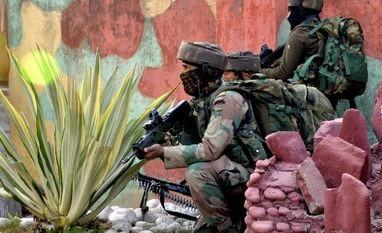
Security personnel takes positions during a militants attack Sunjuwan Army camp in Jammu
BS Web Team New Delhi
Last Updated : Mar 06 2018 | 12:08 PM IST
Sunjuwan Army camp terrorist attack mastermind and top Jaish-e-Muhammad (JeM) commander Mufti Waqas was on Monday killed by the Indian Army and the Special Operations Group in south Kashmir's Pulwama district. The JeM terrorist was killed in an operation described as a "surgical attack" by the Army.

 Defence spokesperson Colonel Rajesh Kalia said "based on specific intelligence about the presence of a terrorist in Hatiwara village of Awantipora", a joint specific operation was launched by 50 Rashtriya Rifles. During the operation, JeM operational commander Waqas -- a category A++ terrorist and the mastermind of the Sunjuwan terrorist attack and the Letpora terrorist attack -- was eliminated, Kalia added.      

According to the spokesperson, Waqas' death will prove to be a major setback for the Pakistan-based terrorist organisation, the JeM.  

Here are the top 10 developments around Sunjuwan Army camp attack mastermind and top JeM commander Mufti Waqas' killing:  
 
1) Who was Mufti Waqas?

Waqas was Jaish-e-Mohammed's operational commander. According to the Army, he was the mastermind of the terrorist attack on the Sunjuwan Army camp in Jammu and the suicide attack on a CRPF camp in South Kashmir's Lethpora.  

According to officials, Waqas was a Pakistani national who had infiltrated into the Kashmir Valley in 2017. He had been functioning as the operational commander of the terrorist organisation and had sent 'fidayeens' (suicide attackers) from Tral in South Kashmir to Jammu where they had carried out the strike on the Sunjuwan Army camp on February 10.  

Further, Waqas was responsible for radicalisng two local youth, Fardeen Khandey and Manzoor Baba. Khandey and Baba had carried out a suicide attack on a CRPF camp in South Kashmir's Lethpora on the intervening night of December 30 and December 31 last year.  

2) Eliminating Waqas has dented JeM's designs

Eliminating JeM's top leadership appears to have been a prime concern for the security forces. 

Colonel Kalia said that Waqas' death has resulted in a major dent to the designs of JeM. "After elimination of their earlier operational commander, Noor Muhammad Tantray, in the same area on December 17, his successor, too, has been killed," he added. 

According to agency reports, the killing of Tantray, who was considered the brains behind JeM's revival in the Valley, was a major blow to the terrorist organisation.  

In December last year, when 47-year-old Tantray was killed, the police called it a "significant development". According to the police, Tantray was wanted in connection with various terrorist incidents from earlier in 2017, including a suicide attack at the BSF camp at Srinagar airport.  

3) How was Waqas neutralised?

The Army said that acting on a specific intelligence input, a small team of the Army and the elite Special Operations Group cordoned off the Hatwar area in Awantipur and carried out a "surgical attack" on a house.  

During the operation, JeM operational commander Mufti Waqas -- a category A++ terrorist -- was eliminated in a surgical operation, Colonel Kalia said. "There have been no civilian casualties or collateral damage," Colonel Kalia added.  


4) Pakistan-backed JeM's role in Sunjuwan attack exposed

On February 10, a group of heavily armed JeM terrorists attacked the Sunjuwan Army camp. While Islamabad denied the involvement of Pakistan-based terrorists in the attack, JeM chief Maulana Masood Azhar did not shy away from claiming credit for his role in the terrorist strike.  

In an audio clip, Azhar bragged about carrying out the attack at the Jammu Army camp that killed five Indian soldiers and a civilian. 

According to a Times of India report, Azhar told his cadres: "Indians are baffled at how our 'mujahideen' reached Jammu from Kashmir. Sunjunwan is not on the border but inside the heart of Jammu." 


5) Pakistan has warned India against cross-border strikes after Sunjuwan

Pakistan has denied any involvement in Army camp attack. Islamabad has also warned New Delhi against cross-border strikes after Indian authorities blamed Pakistan-based JeM for the attack on the Sunjuwan Army camp, in which soldiers and their families were targeted.  

"It is a well-established pattern that Indian officials begin making irresponsible statements and levelling unfounded allegations, even before any proper investigation in any incident has been initiated," Pakistan's foreign ministry said in a statement.

"We hope that the international community would urge India to stop the untold atrocities and gross violation of human rights in IoK (Indian Occupied Kashmir) (and) refrain from any misadventure across the Line of Control..." it said. 


6) India says Pakistan will pay for its 'misadventure'

Pakistan will pay for its "misadventure" and India reserves the right to respond at a "time of its choosing", Defence Minister Nirmala Sitharaman had said last month, while blaming Islamabad for the terrorist attack at the Indian Army's Sunjuwan military camp in Jammu.   

After a visit to the Army camp, Sitharaman also said that Islamabad was expanding its "arc of terror" to areas south of the Pir Panjal Range in the Jammu region. 

"Pakistan will pay for this misadventure. I repeat, Pakistan will pay for it," the defence minister had told reporters in Jammu. "I would not certainly set a timeline but Pakistan will pay for this misadventure. I can only assure the people of Jammu and Kashmir and the entire country that the Army, both the governments at the state and the Centre, are definitely looking at it with all seriousness," she said. 


7) JeM terrorists who attacked Sunjuwan camp came from Pak 8 months ago

Army sources have told news agencies that the three JeM terrorists who carried out the attack on the Sunjuwan military camp had infiltrated into Kashmir from Pakistan in June last year.  

According to the Army's preliminary investigation, the three terrorists were hiding in various parts of Jammu and Kashmir for the past seven months and were looking at carrying out an attack. The terrorists had crossed over to India from Pakistan in June last year when infiltration had gone up, the sources said. They said that a detailed investigation was being carried into the Sunjuwan attack and the probe report would be examined by the top echelon of the Army.

Six Army personnel and a civilian were killed in the attack on the Sunjuwan military station on February 10. Three JeM terrorists, who carried out the strike, were killed during the gun battle with the Army.

8) India will share evidence with Pakistan

While Pakistan has denied the hand of terrorists operating from its soil in the Jammu Army camp attack, India has said it will provide evidence to Islamabad regarding the terror strike.   

In February, when she was asked whether the government was sharing evidence with Pakistan, Sitharaman had replied in the affirmative. "Yes, all the evidences which have been collected will be compiled and, definitely, the evidences will be given, as always, to Pakistan. But, Pakistan, inspite of being given dossier after dossier, has not taken any action, she said. "On the contrary, we find people directly responsible for the Mumbai attack and many others still free and roaming happily in Pakistan," the defence minister added.

She had said that the Centre would provide evidence to prove that the handlers of the terrorists were back in Pakistan and were influencing the attack. 

9) IEDs, 'incriminating' documents recovered

Inspector General, Kashmir Range, SP Pani told news agencies that "weapons and incriminating materials" like improvised explosive devices were recovered from the spot. Further, Pani said that "preparation documents" were recovered from Waqas' body.   


10) Threat not over yet as hundreds of terrorist ready to cross into India

However, Waqas' death does not diminish the threat to India as, according to reports, scores of terrorists are waiting in Pakistan, ready to cross into India. 

Last month, the Army had said that more than 300 militants were waiting across the Line of Control (LoC) in Pakistan to infiltrate into India. The Army had added that the Pakistan Army played a key role in planning terrorist attacks in Jammu and Kashmir. 

Lt Gen Devraj Anbu had said: "(A total of) 185-220 terrorists in the south and 190-225 terrorists in the north of Peer Panjal are ... ready for infiltration."    
With agency inputs

One subscription. Two world-class reads.

Already subscribed? Log in

Subscribe to read the full story →
*Subscribe to Business Standard digital and get complimentary access to The New York Times

Smart Quarterly

₹900

3 Months

₹300/Month

SAVE 25%

Smart Essential

₹2,700

1 Year

₹225/Month

SAVE 46%
*Complimentary New York Times access for the 2nd year will be given after 12 months

Super Saver

₹3,900

2 Years

₹162/Month

Subscribe

Renews automatically, cancel anytime

Here’s what’s included in our digital subscription plans

Exclusive premium stories online

  • Over 30 premium stories daily, handpicked by our editors

Complimentary Access to The New York Times

  • News, Games, Cooking, Audio, Wirecutter & The Athletic

Business Standard Epaper

  • Digital replica of our daily newspaper — with options to read, save, and share

Curated Newsletters

  • Insights on markets, finance, politics, tech, and more delivered to your inbox

Market Analysis & Investment Insights

  • In-depth market analysis & insights with access to The Smart Investor

Archives

  • Repository of articles and publications dating back to 1997

Ad-free Reading

  • Uninterrupted reading experience with no advertisements

Seamless Access Across All Devices

  • Access Business Standard across devices — mobile, tablet, or PC, via web or app

Next Story




