Responding to the public mood, Prime Minister Narendra Modi and the Union government on Monday continued to keep up the pressure on Pakistan but reined it the rhetoric of war.
In New Delhi, Modi chaired a meeting to review the 56-year-old India-Pakistan Indus Water Treaty. "Blood and water cannot flow together," he said, according to sources present at the meeting.
It was decided India would "exploit to the maximum" water of rivers that flow into Pakistan - Beas, Ravi, Sutlej, Indus, Chenab and Jhelum - in accordance with the 1960 pact.
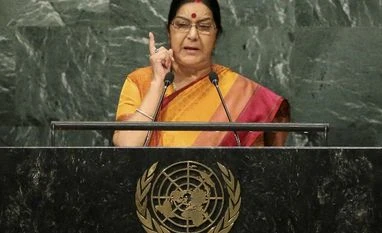
In New York, in an 18-minute speech at the United Nations General Assembly (UNGA), External Affairs Minister Sushma Swaraj lashed out at Pakistan for exporting terror to India, referring to the recent attack at a forward army base at Uri in Jammu & Kashmir. Eighteen Indian soldiers were killed in the attack.
Swaraj said Pakistan was under the illusion that it would acquire Indian territory by engineering terror attacks. "Pakistan should abandon this dream (of acquiring Kashmir). Jammu & Kashmir is an integral part of India and will remain so."
For the first time, India raised the Balochistan issue at the UNGA. Swaraj also brought up Pakistan's role in perpetrating the "worst form of state oppression" in its Balochistan province.
She criticised Pakistani Prime Minister Nawaz Sharif's speech last week at the UNGA, where he accused India of human rights violations in Kashmir. Swaraj said "those who live in glass houses shouldn't throw stones at others".
In a reference to Jamaat-ud-Dawa chief Hafiz Saeed, the mastermind of 26/11 Mumbai terror attacks, Swaraj said there were nations "in our midst" where UN-designated terrorists roamed freely. She said countries that speak the language of terrorism, nurture it, peddle it and export it should be isolated.
Contradicting Sharif's claims that India has set impossible preconditions on talks, Swaraj said. "Did we impose any precondition when I went to Islamabad and agreed to begin the Comprehensive Bilateral Dialogue? Did we impose any precondition when PM Modi travelled from Kabul to Lahore?"
She said India attempted an unprecedented "paradigm of friendship" with Pakistan over the past two years. In return, India was at the receiving end of the terror attacks at Uri and Pathankot.
Swaraj said Bahadur Ali, an alleged terrorist in India's custody, had revealed Pakistan's complicity in cross-border terror.
At the meeting in New Delhi on the Indus Water Treaty, it was decided to set up an inter-ministerial task force with a "sense of urgency".
Attended by National Security Advisor Ajit Doval, Foreign Secretary S Jaishankar, the water resources secretary, and senior Prime Minister's Office officials, the meeting also noted the Indus Water Commission could meet only can "only take place in atmosphere free of terror". The commission has had 112 meetings so far.
The meeting also agreed to review the "unilateral suspension" of 1987 Tulbul navigation project. The project was suspended in 2007.
Sources said India, an upper riparian state, has been very "generous" to Pakistan, a lower riparian state, sharing water as a "goodwill" gesture.
The government decided to expedite work on three dams - Pakal Dul, Sawalkot and Bursar - on the Chenab river.
Sources said under the treaty, water can be used to irrigate 9.12 lakh acres, which can be extended by another 4.2 lakh acres. India was only using it for 8 lakh acres.
Asked if China would react to India's decision, sources said Beijing was not a party to the Indus Water Treaty and noted that it was already building dams on the Brahmaputra, water of which was shared by both countries.

 "Swaraj aims Baloch barbs at Pak, India reviews Indus pact")


 Connect with us on WhatsApp