The Webb Telescope, NASA's golden surfer, is almost ready, again

Thirty years, $8.8 billion, multiple mishaps and budget crises and a threatened congressional cancellation later, the James Webb Space Telescope is finally ready
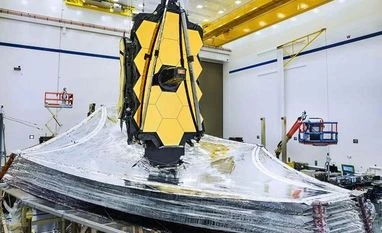
James webb telescope
NASA plans to launch it into orbit as early as October 31 aboard an Ariane 5 rocket supplied by the European Space Agency, from a site in French Guiana
Dennis Overbye | NYT
2 min read Last Updated : Feb 03 2021 | 10:26 PM IST
Birthing a new space telescope takes a long time and a lot of money and inspiration. Astronomers first began pestering NASA for the successor to the Hubble Space Telescope even before that telescope was launched into orbit in 1990. Back then they thought it could cost less than a billion and be ready in the first decade of the 21st century.

Thirty years, $8.8 billion, multiple mishaps and budget crises and a threatened congressional cancellation later, the James Webb Space Telescope is finally ready. NASA plans to launch it into orbit as early as October 31 aboard an Ariane 5 rocket supplied by the European Space Agency, from a site in French Guiana.

During a recent meeting of the American Astronomical Society, technicians and engineers showed off the telescope for what they hoped would be the last time to humans on the ground. “The next time the observatory looks like this,” said NASA’s Eric Smith, a scientist for the telescope, “it will be beyond the moon and appear to us as a roughly 17th-magnitude point source”.

Assembled in its clean room at Northrop Grumman in Los Angeles, the telescope, as viewed over a virtual “town hall” meeting during the conference, resembled a giant sunflower riding on a surfboard. The flower’s petals are 18 gold-plated beryllium hexagons joined to form a dish more than 20 feet across. The surfboard, on which it will float eternally on the far side of the moon, is a sandwich of five layers of a plastic called Kapton that will shield the telescope from the sun.

The telescope, named for the administrator who led NASA through the Apollo programme, is almost three times larger than the vaunted Hubble and seven times more powerful in its ability to discern faint stars and galaxies at the edges of time.

The New York Times


One subscription. Two world-class reads.

Already subscribed? Log in

Subscribe to read the full story →
*Subscribe to Business Standard digital and get complimentary access to The New York Times

Smart Quarterly

₹900

3 Months

₹300/Month

SAVE 25%

Smart Essential

₹2,700

1 Year

₹225/Month

SAVE 46%
*Complimentary New York Times access for the 2nd year will be given after 12 months

Super Saver

₹3,900

2 Years

₹162/Month

Subscribe

Renews automatically, cancel anytime

Here’s what’s included in our digital subscription plans

Exclusive premium stories online

  • Over 30 premium stories daily, handpicked by our editors

Complimentary Access to The New York Times

  • News, Games, Cooking, Audio, Wirecutter & The Athletic

Business Standard Epaper

  • Digital replica of our daily newspaper — with options to read, save, and share

Curated Newsletters

  • Insights on markets, finance, politics, tech, and more delivered to your inbox

Market Analysis & Investment Insights

  • In-depth market analysis & insights with access to The Smart Investor

Archives

  • Repository of articles and publications dating back to 1997

Ad-free Reading

  • Uninterrupted reading experience with no advertisements

Seamless Access Across All Devices

  • Access Business Standard across devices — mobile, tablet, or PC, via web or app

Topics :NASAhubble space telescopeTelescopeEuropean Space Agency

Next Story



