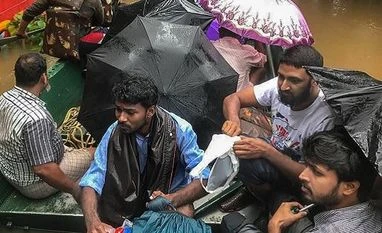
The main day of this year's Onam falls on Saturday. Though devastated by floods, Keralites will put on their happy faces to welcome King Mahabali, the mythical, righteous king who must have watched from netherworld the sufferings of his people and now 'comes to visit them'.
This festival falls on the tenth day from the day of Atham, during the Malayalam month of Chingam. On this occasion, people dress in the attire of Mahabali and take over the roads and shopping malls in Kerala. Celebrations abound.
One of the most popular sites during this time is Kuttanad, the rice bowl of Kerala and one of the major Ramsar sites (wetlands which have international importance). The snake boat races and greenery of Kuttanad are huge attractions for tourists who flock there. This time though, almost the entire Kuttanad is in relief camps, in Alappuzha and Changanessery, as the flood waters, which have taken over their agricultural lands, refuse to recede.
The roads in Kuttanad, which are usually flanked by paddy fields in various shades of green, are inundated by flood water. A few houses dot the deluge.
The disaster during this monsoon, starting early June, has claimed over 370 lives and affected over one million people in 13 out of the 14 districts in Kerala.
Relief camps have popped up at several places.
"Almost 2,00,000 people have been rescued and there are 62 relief camps in Alappuzha alone," said D Lakshmanan, Pallathuruthy Ward Councelor. Lakshmanan is also leading the relief camp at Thiruvambadi School where around 450 families are taking shelter. Most of them were rescued by police, fire force, fishermen, and volunteers, while the others, from the interiors, were airlifted.
Chief Minister Pinarayi Vijayan has said the number of relief camps has come down from 3,314 on Wednesday to 2,774 on Thursday, the number of in those camps from 3,27,280 to 2,78,781 and total individuals in the camps from 1.2 million to 1.04 million on Thursday. The trouble persists though.
In a relief camp at Higher Secondary School in Alappuzha's Thiruvambadi, 68-year-old Gopalan says it'd be several days before he gets a view of his house -- the one his family built near their small parcel of agricultural land in Pallathuruthy, a decade back.
"We don't have Onam this year. It has been seven days here. My paddy was at 28 days when water filled the entire Kuttanadu," Gopalan said.
Another flood refugee Vishnu said the flood-water was "swift", and S M Rasheed, an autorickshaw driver said "I am 64, and in all these years, I have never seen water rising to this level".
Vinod V, a paddy grower, said: "While the water is receding, it may take another 10 days for it to fully drain."
The current crops lost, many other paddy growers like him have no idea how to repay their loans. They fear that the loan sharks they borrowed from will hound them once they get back to their home.
The situation is same across Kuttanad, including Chambakkulam, Nedumudi, Kavalan, Kayikkara and other areas.
As for other districts, Kochi, which wasn't fully inundated, suffered with water from Periyar engulfing many of its streets and neighbouring towns, like Aluva. People from these towns usually come to Kochi do their shopping. But at present, many of them have lost their shelter and are either still at the relief camps or back at home cleaning the mud and carcass of their cattle and fighting snakes in and around their houses.
The textile shops and jewellery shops are not seeing the footfall like the ones they did in previous years. Some of the industrial units have decided to run on less manpower.
"Usually, this would be the busiest season for every trader and shopkeeper in Kochi. I have not seen people buying clothes or coming for stitching clothes for the last two weeks," said a tailoring shop owner in Kochi.
Needless to say, the financial loss due to the floods has been huge.
Kerala State Small Industries Association (KISSIA) says it has yet to assess the losses.
"We will request the state and the central governments to allow special packages or exemptions so that the workers can get back to work and regain the losses," Damodar Avanoor, state president of KISSIA said.
The plantation sector is also facing heavy losses, with initial assessments of losses at around Rs 7-8 billion, said Ajith Balakrishnan, secretary, Association of Planters of Kerala (APK).
"The worst affected are the plantations in Idukki, where the transport is still through the single line, the plantations in Wayanad, and Nelliyampathi in Palakkad, which are mostly inaccessible even now. In some of these places, landslides have occurred in the plantation and the losses like that are yet to be assessed. At Kottayam, the rubber plantations has been affected," said Balakrishnan.
While the government has released an initial estimate of losses to the tune of around Rs 200-300 billion, the industry says it is expecting around Rs 250 billion losses apart from this, including the opportunity losses during the Onam season. "We are yet to assess the full damage and will approach the government for assistance soon," said S Sajikumar, chairman of CII Kerala State Council.
The farmers are now counting on the government to come out with support packages. The banks have already announced rescheduling of loans and other relief measures and the government has assured steps to be taken towards reducing the burden of the farmers. The government is also in talks with the banks to provide Rs 1,00,000 loan to the woman in each affected family, to purchase the essentials lost in the flood.