Home / India News / Uttarakhand Burns: Road ahead for the state
Uttarakhand Burns: Road ahead for the state
The recent forest fires in Uttarakhand torched more than 2,000 hectares. In the last of a three-part series, Business Standard looks at how community engagement is crucial in fighting forest fires
Many observers have noted the growing friction between the forest department and villagers, mainly because villagers are restricted from using resources from reserve forests
On a drizzly Sunday morning, around a hundred students and teachers gathered at the gates of All Saints' School in Nainital. Led by environmental activist Ajay Rawat, they came to pick up all the flammable organic matter on the forest floor and put it in composting pits, to prevent a fire.
"Pine needles and twigs had become so dry that they were an inferno waiting to happen," said Rawat.
During the exercise, students discussed ways to prevent forest fires. "We should know what to do, for we live here and want to save our forests," said one of the students.
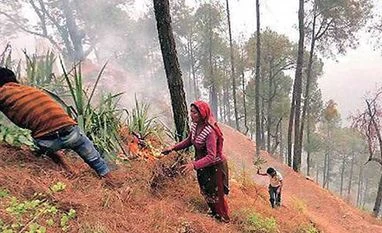
Uttarakhand government could learn a crucial lesson from these students. Across the world, governments involve, train and empower local communities to put off forest fires before they spread. In Uttarakhand, however, the community has been excluded from this exercise altogether.
"The focus of the forest department has remained the same since it was established by the British, i.e. revenue generation - not conservation, afforestation and community participation," said Mukti Dutta, Binsar-based environmentalist. "If the government engages local villagers to clear fire lines, plant local trees and create seedling nurseries, they would feel more like they have a stake in the well-being of the forests."
Instead, many observers have noted, the friction between the forest department and villagers has been growing, mainly because villagers are restricted from using forests resources. "A massive snowfall in December 2014 caused a lot of trees and branches to fall in Binsar. Even though allowing locals to clear the debris of fallen trees inside the buffer zone of the sanctuary would have given them access to timber and kept the forest floor free from flammable organic matter - the forest department didn't allow them. The result is that today, because of huge buildup of dry organic matter, 80 per cent of Binsar forest has been burnt…" said Dutta.
The growing distance between local communities and the forests is worrying. "Most of the fires today are caused by sheer negligence, or worse, on purpose, because of discontentment with the way forests are being managed," said KC Suyal, joint secretary, Forest Rangers Association, Uttarakhand.
The other procedural failure is that forest fires are not recognised as National Disasters. This might be because of the erroneous but popular belief that fires are a natural aspect of the forest ecology. This is one reason why the government responded to the emergency in Uttarakhand very late.
"By recognising forest fires as National Disasters, the government will acknowledge that they are not natural," said Rawat. Further, such a move would create awareness among local communities to engage in fire-safety practices, not throw smouldering cigarette/beedi butts in the forest or burn crop waste close to the forests," he added. Most importantly, the government will be compelled to take timely action with involvement of the army or Indo Tibetan Border Police Force, when needed.
Increasing community participation and recognising forest fires as national disasters will both require policy changes. The destruction caused by recent fires should push all stakeholders to do everything possible to save what is left of the great Himalayan forests.

 "Uttarakhand Burns: Road ahead for the state")


 Connect with us on WhatsApp