
What is Disaster Management Act? Terms you should know in time of Covid-19
Prime Minister Narendra Modi today announced nationwide lockdown for three weeks
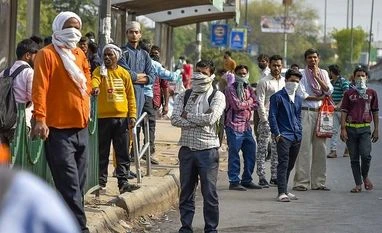 "What is Disaster Management Act? Terms you should know in time of Covid-19")
premium
WebinarsNew
Deep DiveNew
Explore Business Standard
Prime Minister Narendra Modi today announced nationwide lockdown for three weeks
Prime Minister Narendra Modi on Tuesday called for a nationwide lockdown starting midnight to contain the coronavirus pandemic which has claimed over 10 lives in India and has infected 515. The duration of the lockdown will be 21 days for 1.2 billion citizens, PM Modi said. Providing a rationale behind this major step, Modi said that it was necessitated due to the severity of the situation.
"It took 67 days for the number of infected cases to rise to 100,000. But, it took only 11 days for the next 100,000 cases to emerge. And, it took just four days for the 300,000 cases to appear. This indicates the speed at which coronavirus is spreading," Modi added.
He stressed that during the 21-day lockdown no individual was permitted to leave the house. The novel coronavirus, or Covid-19 pandemic has spread across at least 190 countries, infecting nearly 400,000 people across the globe, and claiming over 17,260 lives.
Laws in the time of coronavirus in India
The Disaster Management Act 2005
The stated object and purpose of the DM Act is to manage disasters, including preparation of mitigation strategies, capacity-building and more. In the popular imagination, a disaster is usually associated with a natural calamity such as a cyclone or an earthquake. Even the definition of a “disaster” in Section 2 (d) of the Disaster Management Act states that a disaster means a “catastrophe, mishap, calamity or grave occurrence in any area, arising from natural or man made causes…”. To address the current epidemic outbreak, the Central government has included the Covid-19 outbreak as “Notified Disaster” as a “critical medical condition or pandemic situation” .
The Epidemic Diseases Act
Under this law, the Central government as well as state government, have the power to take special measures and prescribe regulations to prevent the spread of a “dangerous epidemic disease”.
An example of this would be the order on March 16 under the Delhi Epidemics Diseases, Covid-19 Regulations, 2020, whereby the Delhi government has restricted gatherings with groups of more than 50 persons till March 31.
What is a lockdown?
A lockdown is an emergency protocol that prevents people from leaving a given area. A full lockdown will mean you must stay where you are and not exit or enter a building or the given area.
This scenario usually allows for essential supplies. All non-essential activities remain shut for the entire period.
In India, the restrictions on movement and services have been enforced by state government, after advisories from the Centre. These restrictions derive their legal basis from the Epidemic Diseases Act, 1897.
What does the coronavirus lockdown mean for Indian citizens?
We are making efforts that there is no difficulty in daily life. We are taking all steps to ensure continuous essential supplies, Modi has said.
— Under the coronavirus lockdown, essential supplies and grocery stores, pharmacies and banks will be open for public. All non-essential activities remain shut for the entire period.
— Essential activities include: Buying groceries and medical supplies. Visit to the doctor in case of medical emergencies will be permitted.
— Private and government offices will be shut
— Religious institutions, schools, colleges will not be allowed to function.
— Hospitals will be open
What is Section 144?
Section 144 of the Indian penal code states that a gathering of four or more people is prohibited in the concerned area. If a gathering of four or more people is found, then every member of the group can be charged for engaging a riot.
Section 144 is imposed in urgent cases of nuisance or to control the danger of some event that has the potential to cause trouble or damage to human life or property.
What is a curfew?
A curfew is an order specifying a time during which certain regulations apply. Typically it refers to the time when individuals are required to return to and stay in their homes.
Already subscribed? Log in
Subscribe to read the full story →

3 Months
₹300/Month
1 Year
₹225/Month
2 Years
₹162/Month
Renews automatically, cancel anytime

Over 30 premium stories daily, handpicked by our editors


News, Games, Cooking, Audio, Wirecutter & The Athletic
Digital replica of our daily newspaper — with options to read, save, and share


Insights on markets, finance, politics, tech, and more delivered to your inbox
In-depth market analysis & insights with access to The Smart Investor


Repository of articles and publications dating back to 1997
Uninterrupted reading experience with no advertisements


Access Business Standard across devices — mobile, tablet, or PC, via web or app
First Published: Mar 24 2020 | 9:52 PM IST


