Home / India News / What Make in India? MoD penalises Tata Power for using indigenous parts
What Make in India? MoD penalises Tata Power for using indigenous parts
Rs 275 cr payment to Tata Power (SED) blocked for putting Indian part
premium
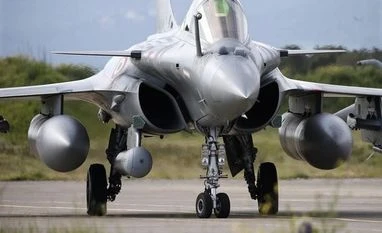
A French Air Force Rafale fighter jet takes part in the close air support (CAS) exercise Serpentex 2016 hosted by France in the Mediterranean island of Corsica, at Solenzara air base
The Prime Minister’s Office (PMO) and ministry of defence (MoD) claim indigenisation – or replacing foreign-procured equipment with kit built in India – is a key priority. Yet, an Indian company that indigenised components faces heavy financial losses after the MoD blocked its payments.
Tata Power (Strategic Engineering Division), one of India’s most capable defence electronics innovators, beat out global competition in 2011 to bag a Rs 1,219 crore contract to modernise 30 Indian Air Force (IAF) and one Indian Navy airfields. But now, even as Tata Power (SED) continues work, the MoD has blocked payments worth Rs 275 crore after the company replaced an Australian component worth just Rs 84 lakh with a component developed in India.
The component, called a “Runway Visual Range” (RVR), was to be sourced from an Australian firm, MTECH Systems, according to the initial contract with Tata Power (SED). However, after MTECH Systems presented delivery problems, Tata Power (SED) – in consultation with the IAF – replaced it with the Drishti RVR, built in India by National Aerospace Laboratory, which falls under the Council of Scientific & Industrial Research (CSIR).
Drishti was already installed in several civilian airfields under the Airports Authority of India, including Bengaluru International Airport. It was also displayed in the Republic Day Parade this year, as an showpiece of “Make in India”.
Yet, the MoD has used Drishti’s induction as grounds to stop payments to Tata Power (SED). Each IAF airfield costs Rs 37.5 crore to modernise. The MoD has blocked that entire amount because of the RVR, which costs just Rs 84 lakhs; less than 2.5 per cent of the cost per airfield.
Despite dues piling up to Rs 275 crore, Tata Power (SED) has continued to work without payment on almost 11-12 airfields. The company calculates it has additionally lost Rs 12.56 crore in interest on the outstanding dues. With each passing day, interest charges lose Tata Power (SED) another Rs 10.6 lakhs.
Rahul Chaudhry, Tata Power (SED) chief, laments: “We proposed the IAF could withhold Rs 94 lakh for each RVR, and pay us the remaining amount. But this arrangement was not acceptable to MoD (Finance) and our payments since then are stuck, leading to a large working capital interest burden of Rs 10.6 lakh per day.”
Business Standard learns that this will cause Tata Power (SED) – a division of Tata Power – to post a loss for the first time in 15 years.
Contacted for comments, MoD officials, speaking anonymously, tell Business Standard the ministry has decided to pay Tata Power (SED). “The proposal to replace the foreign RVR with an indigenous one had been agreed to several weeks ago. However, the case has been held up on account of costing implications in the contract. But agreement has been reached and [the IAF] will make the payment soon.”
However, Tata Power (SED) says the MoD has not communicated any decision to make payment, or when it would be made. “We are waiting for our due payment (of Rs 275 crore) and requesting an immediate release. We are also requesting that our cost (of Rs 12.56 crore) on account of blocked working capital may be reimbursed”, says Chaudhry.
Under the so-called Modernisation of Airfield Infrastructure (MAFI) contract, Tata Power (SED) is required to supply, install, test, integrate and commission a range of radar, airspace control and communications equipment, procured from various foreign and Indian vendors at 31 specified IAF/navy airfields.
Negotiations are under way with Tata Power (SED) for a second phase of this project, termed MAFI-2, to modernise another 37 military airfields for an assessed Rs 1,600-1,800 crore.
Read this article for free
Register to continue reading premium journalism and analysis from Business Standard.

 "What Make in India? MoD penalises Tata Power for using indigenous parts")












 Connect with us on WhatsApp