With 73% Indians trusting in Modi govt, India tops in govt reliance: Report

Decided by whether it's able to protect citizens from risk and effectively deliver public services
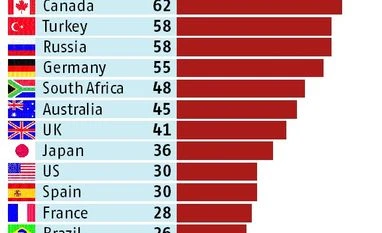
reliable government
Business Standard
Last Updated : Jul 16 2017 | 12:32 AM IST
Trust can be understood as a positive perception about the actions of an individual or an organisation. This positive perception can be grounded in actual experience, but is determined to a large extent by the subjective assessment of individuals. It serves as a driving force for a country’s economic development, makes governmental decisions more effective and leads to greater compliance with regulations and the tax system. Government trust levels are generally determined by whether or not people consider their government stable and reliable, if it’s able to protect its citizens from risk and whether it can effectively deliver public services.

According to the latest edition of the OECD’s Government at a Glance report, confidence in government fluctuates widely between countries. With 73 per cent, India is at the top of the governmental confidence league while Canada also had higher than average confidence levels at 62 per cent. In the United States, where fake news, scandals and allegations about Russian collusion are still dogging the White House, only 30 per cent of people have confidence in their government. In the United Kingdom (UK) which is attempting to negotiate an amicable divorce from the European Union, trust stands at 41 per cent. In Russia and Turkey, Putin and Erdogan’s governments are both trusted by 58 per cent of their respective citizens.

In recent years, Greece had to contend with being on the frontlines of Europe’s migration crisis, multiple elections, bank shutdowns, defaulting and the introduction of capital controls hence it is not surprising to see it at the very bottom of the government trust league.

Methodology

Measures of trust in government frequently rely on evidence from perception surveys. Data are derived from the Gallup World Poll. It collects data based on proportional stratified probability sampling and uses a sample of around 1,000 citizens for most countries.


One subscription. Two world-class reads.

Already subscribed? Log in

Subscribe to read the full story →
*Subscribe to Business Standard digital and get complimentary access to The New York Times

Smart Quarterly

₹900

3 Months

₹300/Month

SAVE 25%

Smart Essential

₹2,700

1 Year

₹225/Month

SAVE 46%
*Complimentary New York Times access for the 2nd year will be given after 12 months

Super Saver

₹3,900

2 Years

₹162/Month

Subscribe

Renews automatically, cancel anytime

Here’s what’s included in our digital subscription plans

Exclusive premium stories online

  • Over 30 premium stories daily, handpicked by our editors

Complimentary Access to The New York Times

  • News, Games, Cooking, Audio, Wirecutter & The Athletic

Business Standard Epaper

  • Digital replica of our daily newspaper — with options to read, save, and share

Curated Newsletters

  • Insights on markets, finance, politics, tech, and more delivered to your inbox

Market Analysis & Investment Insights

  • In-depth market analysis & insights with access to The Smart Investor

Archives

  • Repository of articles and publications dating back to 1997

Ad-free Reading

  • Uninterrupted reading experience with no advertisements

Seamless Access Across All Devices

  • Access Business Standard across devices — mobile, tablet, or PC, via web or app

Next Story



