Tamesh Chauhan was just five months old when his parents realised that he suffered from hearing impairment. His parents took him to a doctor and got a hearing aid, but that wasn’t enough.
“When he was nine, we went for a cochlear transplant. After that, with the help of therapy, he (Tamesh) slowly learnt to communicate like everyone else. Now, he attends school like other children, and does not face any difficulty in hearing, or carrying out any task,” Jyoti, the mother of the child, said, as Tamesh prepared to attend an online session.
According to estimates by the World Health Organisation (WHO) — which observes March 3 as World Hearing Day every year — there are about 63 million people in India, who are suffering from significant auditory impairment. This places the estimated prevalence at 6.3 per cent in the Indian population and children up to 14 years constitute a significant percentage of this.
“Four in every 1,000 children in India suffer from severe to profound hearing loss. With over 100,000 babies born with hearing deficiency every year. WHO estimates that 50 per cent of hearing loss can be prevented through public health measures, which can be restored by the use of a hearing aid or cochlear implant if identified early,” says Shweta Rawat, chairperson and founder of The Hans Foundation, a public charitable trust which has funded and facilitated many cochlear transplants among children.
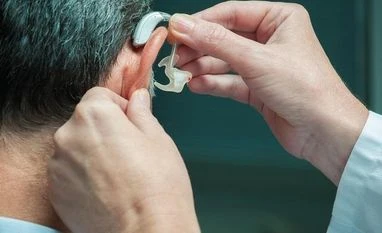
Rawat said hearing aids were a temporary solution to address noise-induced hearing loss. “Once the hearing aid is removed, the person is unable to hear anymore. Cochlear implant surgery consists of cochlear implants, a medical device that allows auditory challenged people to receive and process, sounds, and speech used to enable people to hear.”
However, this, too, has challenges. “Since this device is attached surgically to the inner and outer ear, it requires maintenance and processor upgrade. It will have a positive impact on people’s lives, but ultimately it’s only a device and a long-time trust is still a challenge,” she said.
On the options to treat hearing disability, Dr Hemal Shah, consultant, ENT, head and neck surgeon, Marengo CIMS Hospital, told Business Standard, “Apart from hearing aids and cochlear implants, surgeries and brainstem implants can restore hearing ability. It depends on the type and severity of hearing loss and the pathology involved. Older people suffering from nerve deafness need hearing aids, whereas deaf and mute children up to seven may need a cochlear implant. In cases of ear pathology causing conduction deafness, surgeries can also be helpful,” Shah said.
The hearing market in India, too, is also on the upswing. “The country’s digital hearing aids market size is valued at $440 million in 2022 and is expected to reach $780 million by 2030, at a compound annual growth rate (CAGR) of 7.5 per cent from 2023 to 2030. This is just the estimate of hearing aids, excluding the treatment cost of surgeries directed for conductive deafness,” Shah said. A cochlear implant costs up to Rs 800,000 in India.
Rawat pointed out that government initiatives, such as District Early Intervention Centers, aimed at early identification and early intervention for children from birth to 18 years, under the National Health Mission's Rashtriya Bal Swasthya Karyakram (RBSK) initiative, were in place, but more awareness was needed on hearing impairment in India “and a separate day demarcated as World Hearing Day will help”.
“Hearing disabilities are not easily spotted, but this profoundly impacts lives. As an “invisible disability”, it is often neglected and the problem compounds in the case of congenital hearing loss due to low awareness around the identification of hearing issues in babies and delayed diagnosis. There is a need to address the core issue and increase the visibility of the issue. Highlighting days such as World Hearing Day can help throw more light on the issue and increase awareness,” Rawat added.

 "World Hearing Day: Awareness as important as treatments to fix impairment")












 Connect with us on WhatsApp