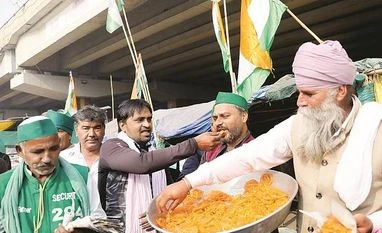
Even as hundreds of thousands of farmers gathered on the streets of Delhi in protest against the now repealed three farm laws, the government moved ahead with some big changes in the manner in which the Minimum Support Price (MSP) mechanism was being administered in the country.
Going forward too, sources said these improvements will continue to happen, all focused on ensuring that only genuine farmers get the benefit of MSP and most of them fall under the ambit of procurement.
That apart, there could also be some reforms in the manner in which fertiliser subsidies are delivered to the farmers.
The agitating farmers have also said that they are not going to end their protest unless a firm guarantee on MSP is given to them.
Officials said though the mandate of the Committee promised by Prime Minister Narendra Modi in his address to the nation yesterday, while announcing the repeal of the three acts, is yet to be spelled out, but it might look at more reforms in the sector that can be accomplished with the active cooperation of states.
Agriculture Minister Narendra Singh Tomar, in his reaction to the announcement of repeal of the contentious acts, has in fact mentioned that the new panel will consider the next set of reform measures for the sector.
Meanwhile, on MSP, the government has already aligned its paddy purchases to the average yield of a district from this year.
This system, which has been in place in most of the paddy and wheat procurement states since the last few years, will now be extended to the entire country, including Punjab.
That apart, the system has also made it mandatory for all states to upload land records of farmers on the state procurement portals, which will now be integrated with a central database.
Not only this, the Centre, in a recent statement, has also laid down some minimum threshold parameters that each procurement portal designed and developed by the state governments need to have.
Each state portal will now be integrated with a centralised system through which it can be monitored centrally how much grain has been procured from each field and how the MSP is transferred into the bank account of farmers.
“The parameters have to be common as by October end all such details will be integrated into a centralised database, which will help in monitoring procurement and payment on a real-time basis with full transparency,” the official explained.
Payment of MSP is also being done electronically.
B Chaudhary of the RSS-affiliated Bhartiya Kisan Sangh (BKS) said that Centre along with states could consider guaranteeing some sort of profitable price for each crop in each region.
“The CACP does calculate the Cost of production region wise, what we suggest is to set up some sort of mechanism for ensuring a profitable price for the farmers because the cost of production of each crop in each place is different. That profitable price can then be paid by anyone who plans to purchase. But, for all this to happen Centre and State have to first sit and talk along with all other stakeholders,” Chaudhury said.
Some experts said broad basing and including more items into the PM-ASHAA scheme could be tried to ensure that some sort of assured purchase to the farmers.
At present, under the PM-ASHAA scheme, only oilseeds and pulses are included.
The Pradhan Mantri Annadaata Aay Sanrakshan Abhiyan or PM-AASHA broadly has three components, which are the Price Support Scheme (PSS), the Price Deficiency Payment Scheme (PDPS) – modeled on the lines of erstwhile Bhawantar Bhugtan Yojana of Madhya Pradesh and Private Procurement and Stockiest Scheme that was launched on a pilot basis.
Under the scheme, the Centre’s total procurement is capped at 25 per cent of the total production of a crop in the state, which can be expanded up to 40 per cent if the commodity is used for PDS or for any other state welfare scheme.
However, previous attempts at deficiency price payment in case of Madhya Pradesh’s Bhawantar Bhugtan Scheme wasn’t very successful over allegations that traders formed cartels to artificially keep the prices down.
There could also be an option to explore something like a minimum reserve price for private traders to buy based on the production cost as estimated by the Commission for Agriculture Costs and Prices (CACP).
However, this could be applicable only for the 23 crops for which CACP determines the production cost.
The Committee for Doubling Farmers’ Income has indeed talked about such a reserve price.
It said there was a need for setting a minimum reserve price, distinct from the MSP such as to protect the interests of the farmers without distorting the market forces as whenever market prices fall before the notified MSP, there is no minimum reserve price for the private trade that is conducted at the markets.
“In laying down a benchmark, care has to be taken to protect the free trade practices since MSP based procurements cannot become universal. It is therefore suggested that the cost of production can become such a reserve price,” the panel had said.
“Price deficiency payment for a wider variety of crops is definitely an option or maybe ensuring some sort of insurance could also be considered, but it must have been remembered by the panel and also everyone else that one-size fits all approach won’t work in the case of agriculture and collaborative approach has to be followed. This to me is the biggest lesson from the farm acts and events surrounding it,” Pravesh Sharma, former Managing Director of Small Farmers Agribusiness Consortium (SFAC) said.