As China races ahead, MoD dithers on India's aircraft carrier

The ministry remains uncertain about spending billions of dollars on a carrier
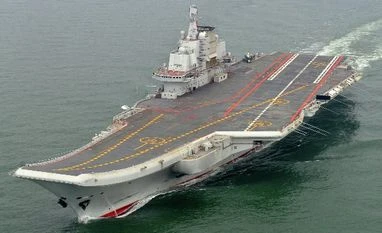
Liaoning
Liaoning
Ajai Shukla New Delhi
Last Updated : Apr 20 2017 | 10:52 AM IST
As Beijing decisively implements its vision of aircraft carrier-based naval power, New Delhi seems uncertain about the form and structure of its naval combat aviation.

Last month China’s defence ministry announced the impending launch of Shandong, its first indigenous aircraft carrier. On Friday, a Beijing-based naval expert revealed that the People’s Liberation Army (Navy)’s, or PLA(N)’s, third carrier could be a US Navy-style nuclear-powered vessel, featuring an electromagnetic aircraft launch system (EMALS). 

In New Delhi, however, a senior navy admiral revealed uncertainty about India’s indigenous aircraft carrier programme. The first indigenous aircraft carrier (IAC-1), named INS Vikrant, will roll out of Cochin Shipyard Ltd (CSL) later this decade. But the navy and the ministry are still making up their minds about its successor, IAC-2.

Vice Admiral D M Deshpande, the navy’s warship acquisition head, stated on Tuesday that the ministry remains uncertain about spending billions of dollars on a carrier.

“Right now there is a bit of a question mark from the ministry’s side, [although] we have taken this up to the ministry on a few occasions. [An aircraft carrier] is a huge ticket item and, before some commitments are made on allocation of these funds everybody wants to be very clear on the requirement, whether we actually need that. So these are being addressed [before] we actually take it up to the government for final clearances”, said Deshpande, addressing defence industrialists in New Delhi.

The three services are competing for the same limited budget. With the cost of INS Vikrant (IAC-1) reportedly nudging $4 billion, the Indian Air Force argues that land-based combat aircraft, with their ranges enhanced with in-flight refuelling, would project offensive air power more cheaply than an aircraft carrier. The navy counters that an aircraft carrier is a mobile air base, that can move to a combat zone quickly.

Even within the navy, some argue that the same amount spent on submarines, or a larger number of smaller surface warships like destroyers, frigates and corvettes, would generate greater combat effect than a carrier.

This is the longstanding debate between sea denial (denying the enemy the use of the sea, primarily with submarines) and sea control (dominating the ocean with air and surface power, built around a carrier). Sea control requires massive spending on carrier battle groups, or CBGs – an aircraft carrier and the warships that accompany it. In contrast, sea denial is a defensive strategy that takes less money – the cost of a submarine-based force.

Powerful, modern navies --- like the US Navy, the Royal Navy, the French, Russian and now even the PLA(N) --- have all built their fleets around aircraft carriers, enabling the projection of power to large distances from home bases.

Although the Indian Navy has decisively opted for aircraft carriers, discussion continues over whether to build a large, nuclear-powered carrier, or a smaller one like IAC-1. Reflecting this, Deshpande says: “There are lots of discussions within the navy on what type of IAC-2 we want. From the tonnage to the propulsion --- we are debating on this. Once we are more or less clear within the navy [about] what exactly we want, we would take up the case with the ministry for various approvals.”

The navy is inclined towards a 65,000-tonne, nuclear powered carrier that embarks 55 combat aircraft; and a state-of-the-art EMALS catapult that can rapidly launch fighter aircraft as well as larger aircraft for electronic warfare and airborne early warning. The name being suggested for IAC-2 is INS Vishal.

Deshpande expresses confidence that “in the next two-three months, we should be in a position to take it up to the ministry to get the funds”. With INS Vikrant likely to be operationally ready only in 2023 – eight years late – there is little time to lose. 

Currently, the PLA(N) operates only its first-ever carrier, the 65,000-tonne Liaoning, which Beijing bought from Russia, refurbished, and commissioned in 2012. India, with far greater experience, has operated at least one aircraft carrier ever since INS Vikrant joined the fleet in 1961.

The PLA(N), however, now plans to commission and operate at least 5-6 carriers. The Indian Navy plans to operate a fleet of three aircraft carriers.

One subscription. Two world-class reads.

Already subscribed? Log in

Subscribe to read the full story →
*Subscribe to Business Standard digital and get complimentary access to The New York Times

Smart Quarterly

₹900

3 Months

₹300/Month

SAVE 25%

Smart Essential

₹2,700

1 Year

₹225/Month

SAVE 46%
*Complimentary New York Times access for the 2nd year will be given after 12 months

Super Saver

₹3,900

2 Years

₹162/Month

Subscribe

Renews automatically, cancel anytime

Here’s what’s included in our digital subscription plans

Exclusive premium stories online

  • Over 30 premium stories daily, handpicked by our editors

Complimentary Access to The New York Times

  • News, Games, Cooking, Audio, Wirecutter & The Athletic

Business Standard Epaper

  • Digital replica of our daily newspaper — with options to read, save, and share

Curated Newsletters

  • Insights on markets, finance, politics, tech, and more delivered to your inbox

Market Analysis & Investment Insights

  • In-depth market analysis & insights with access to The Smart Investor

Archives

  • Repository of articles and publications dating back to 1997

Ad-free Reading

  • Uninterrupted reading experience with no advertisements

Seamless Access Across All Devices

  • Access Business Standard across devices — mobile, tablet, or PC, via web or app

Next Story



