Home / Economy / News / At full steam, it will take another 108 days to replace old notes
At full steam, it will take another 108 days to replace old notes
Even if India's currency presses which produce 63 million notes every day were to triple production it would take another 108 days to replace 22 billion Rs 500 and Rs 1000 notes
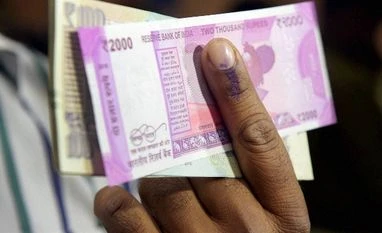
A man shows his inked finger and exchanged currency notes at a SBI branch in New Delhi
While the number of people queuing outside ATMs and banks is increasing by the day, the government’s currency presses may find themselves overstretched to print more money.
A simple calculation would show that if the government presses were to work overtime, it would take exactly a year to replace 22 billion currency notes that have been termed illegal tender.
India’s currency is printed at four presses across the country. Two presses are operated at Mysore and Salboni by the RBI. The Indian government meanwhile operates two at Nashik and Dewas. Meanwhile some notes are also printed at the watermark paper manufacturing unit at Hoshangabad. This unit, though has faced mechanical failures in the past and production is believed to be limited. The RBI runs its presses through a company called Bharatiya Reserve Bank Mudran Private Limite(BRMPL) wholly owned by it. The government presses are run by the Security Printing and Minting Corporation of India Limited (SPMCIL), also completely owned by it .
The two RBI presses produced 15.2 billion pieces of currency in 2014-15 according to data available in the company’s balance sheets. The government presses meanwhile produced 8 billion pieces of currency in 2013-14, the period till which data is available with its company. So India produced 22 billion pieces of currency every year in all its currency presses across India.
Now the government will be replacing 22 billion currency notes after it declared them illegal tender. The government has to replace 15.67 billion pieces of Rs 500 currency and 6.32 billion pieces of the Rs 1000 denomination. There are three ways in which the government can replace the Rs 1,000 denomination.
If it decides to replace all Rs 1,000 notes with the new Rs 2,000 notes, then it will have to replace half the number of Rs 1,000 denomination taken out of circulation. That works out to be almost 2.2 billion new Rs 2,000 notes. If the government decides to replace them with new Rs 500 notes, then it will have to print double the number. That works out to be almost 13 billion new notes. Alternatively, the government can decide to replace the Rs 1,000 denomination with both Rs 500 and Rs 2000 notes in which case it will print fewer notes.
At present levels all four presses owned by the government and RBI print 63 million notes every day. The government has to replace 22 billion notes which have gone out of circulation. If these presses operate at their current levels, it would take 349 days to replace all the notes.
Certain reports suggest that the RBI started printing the new notes at its facility in Mysore from September this year. The RBI’s other facility at Salboni and the government’s presses at Nashik and Dewas did not start printing in September.
Assuming that these reports are true, then one facility of the RBI printed notes for 69 days before PM Modi announced his demonetisation move on the evening of November 8. Both RBI presses print 41 million notes every day. Assuming both do the job equally, then one press prints almost 21 million a day. If the RBI’s Mysore unit was producing 21 million notes every day for 69 days, then it means that the RBI had already printed almost 1.4 billion currency notes before PM Modi made the announcement at 8 PM on November 8 this year.
So at the time PM Modi made the announcement to replace 22 billion currency notes, it had printed only 1.5 billion notes. This explains the massive chaos and serpentine queues being currently witnessed outside banks and ATMs.
Now this means that from the day Modi made the announcement, 20.5 billion notes still remained to be printed. Now assuming that all four presses in India work at normal capacity (63 million notes a day), then it would still take another 325 days to replace all the currency in the Indian economy.
Even if all four currency presses work around the clock and workers work three shifts to print 189 million notes a day, it would still take another 108 days to replace the currency. That means that queues outside banks and ATMs could go on till February, even though the current footfall being witnessed could moderate by December.
It is in this context that PM Modi’s statement that things would improve from December needs to be viewed. Business Standard has already expressed its views that the government must import currency notes urgently to avoid an economic shock. This paper has emphasized that placing orders with foreign printing presses, both public and private, to remonetise the economy is the need of the hour. This could be the crucial difference between a bold policy success or a colossal failure of the Modi government.

 "At full steam, it will take another 108 days to replace old notes")


 Connect with us on WhatsApp