Bengaluru institutions dedicated to handloom sari help keep legacy alive

Bengaluru's handloom heritage has brave new showcases. They are rife with fascinating personal stories - of weaver and aficionado alike
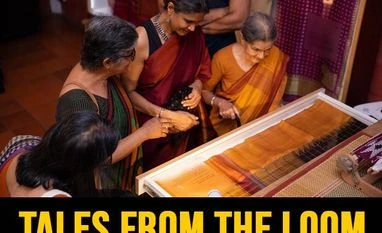
Visitors to the Vimor Museum in Bengaluru
Nikita Puri
8 min read Last Updated : Jul 20 2019 | 1:46 AM IST
The mythical two-headed bird, gandaberunda, and swans perched on deer feature alongside jacquard patterns all along the vivid pink silk sari that is encased in glass and mounted on the wall. But Pavithra Muddaya’s eye quickly moves across these patterns to be finally arrested by the elephant motifs on the sari’s borders. Revivalist, designer, teacher of aesthetics, historian and businesswoman, the 61-year-old wears many hats — and all for the love of handloom.

The elephant motif on this sari interests her particularly because of the unusual “curve” of its head. The sari is easily 60 or 70 years old, and its provenance unknown. But because she has encountered the elephant’s distinctly shaped head a few times before, she recognises it as yet another undocumented pattern in the history of Indian textiles. She should know, she’s been doing this for 45 years.

An ongoing handloom workshop at The Registry of Sarees
A red-brick bungalow in a bylane in Bengaluru’s Austin Town is home to Muddaya and some of her saris. Now, the first floor of this building houses a physical archive called the Vimor Museum of Living Heritage to showcase the textiles she’s collected over the decades. “This is ‘living heritage’ because these are living memories of all the people who’ve owned them before. They continue to live through design revival, and will live on in the future as they create livelihood opportunities by inspiring weavers.”

“Patrons have just handed over their heritage saris so that I could document them,” says Muddaya. These patrons, who walk in freely to be taken around by Muddaya, have in their own ways been a part of her family — ever since Muddaya and her mother, the late Chimy Nanjappa, established the Vimor label in 1974. Bengalureans remember Nanjappa as the grand old lady of handloom, and as the first manager of the city’s Cauvery Arts and Crafts Emporium.

Artifacts at the Vimor Museum
“There is some amount of documentation of the weaves commissioned by royals, but one can’t say the same about textiles that didn’t have that royal patronage. This is where this museum steps in,” says Muddaya. That makes this modest museum, filled with saris, headgear and carpets that came from someone’s home, a veritable “people’s museum”. This is as true of the short 3.15-metre sari meant for young girls in South India, on display at the Vimor Museum, as it is for the grand “temple sari” showcased here. A thanksgiving offering, temple saris were specially commissioned to be donated to the temples after a person’s prayers were answered.

Muddaya and her Vimor Museum aren’t alone in their quest to conserve the tradition of hand-woven textiles in Bengaluru. When actor Deepika Padukone bought her wedding saris from the Angadi store, it shone the spotlight on a shop which has previously dressed Indira Gandhi. But the interest in textiles has gone beyond just buying them, as the busy calendar of The Registry of Sarees demonstrates.

Located in Bengaluru’s Domlur area, The Registry of Sarees is a research and study centre that was established in 2016. Currently seated here are five participants taking their first steps towards becoming weavers. One of the five wants to use the two-week workshop to make the switch from graphic designer to textile artisan, and another is here to learn the skill and pass it on to the children she works with.

pavithra muddaya, Co-founder, Vimor
The Registry of Sarees recently wrapped up a travelling exhibition (Meanings, Metaphor — Handspun and Handwoven in the 21st Century) which displayed the saris and swatches originally commissioned by textile specialist Martand “Mapu” Singh for a series of exhibitions titled Khadi – The Fabric of Freedom a few decades ago. Two stops en route were Chirana, a weaver’s village in Rajasthan, and Lakshmi Mills, one of the oldest textile hubs in Coimbatore. The idea, says Ahalya Matthan, the Registry’s co-founder, was to take the exhibition to weavers who would not normally have access to shows of this kind. Besides Singh’s Khadi collection, all of the study centre’s research and documentation is open for public viewing.

Matthan’s centre is a curated collection with an academic bent, but Vimor’s collection holds personal histories, which Matthan describes as a “great act of generosity”. But for the self-effacing Muddaya, who has a history of being as involved with the loom as the weavers themselves, the true generosity owes to the patrons who contributed their saris. Like businessman Premraj Bhandari, who sourced saris for Vimor from places such as temple auctions. Or Jayanthi Sachidanand, a customer and friend whose contribution is easily a hundred years old — a silk sari which appears to be from Andhra Pradesh, it has Islamic motifs with meenakari (multi-coloured threads) embroidery at the centre, and dhows on the bottom.

One of the saris in Muddaya’s collection features motifs such as autos and gramophones. “The weaver made four of these and refused to make any more because the children from the village would peep in through his window and laugh at the design. We are trying to explore other fabrics with those patterns now,” she says.  

Besides documenting patterns, Muddaya’s work also involves keeping various motifs alive and constantly learning new patterns — and sometimes their names. For instance, a weaver from Chennai once referred to a pattern of dotted squares as the “LIC design”, which baffled her. The reference proved to be to the Life Insurance Corporation of India’s first building in Chennai. At 177 feet tall, it was the first skyscraper in the city and remained the tallest building for 35 years.

Muddaya also helps the weavers she works with to be more productive. For instance, when the weavers found using an inch tape to measure squares a bother, she brought in the tamarind seed technique. “Everyone is familiar with how big the tamarind seed is; it’s a household item. They didn’t need to stop and measure after every square.”

Vimor, born out of financial necessity after Chimy Nanjappa lost her advocate husband, has come a long way since Muddaya would get patterns embossed onto saris after she finished her pre-university classes. The mother and daughter started out by selling these saris, banking on Nanjappa’s learnings from her Emporium days.

For weavers, knowing that Vimor would buy the saris they made has over the years given them the crucial sense of security and the confidence to maintain their craft. “It’s because of Pavithra Muddaya and her mother that I’ve been able to buy 10 houses,” says Tulsi Ram, a weaver from a village near Kanchipuram, who wants to put Nanjappa’s picture in his puja room. The request has been strongly rejected. “My mother wouldn’t have liked that,” Muddaya says.

Tulsi Ram also prides himself on naming a pattern on behalf of Vimor, a memory that evokes great laughter from Muddaya. When Sonia Gandhi once visited Vimor, she spotted a swatch of dark green material with tiny green checks and requested a sari customised along those lines. Later, when they wanted to name the motif, Tulsi Ram decided to call it “Sonia”. Shabana Azmi, Nandita Das, Ratna Pathak Shah, Wendell Rodricks and Shubha Mudgal are just a few of their contemporary celebrity clients; Nanjappa is even believed to have gifted saris to Jacqueline Kennedy and Queen Elizabeth II.

The museum currently has about 50 saris on display, besides items such as a scarf woven by a weaver from Varanasi that belonged to Muddaya’s grandmother, and a carpet that was gifted to her parents on their wedding over 60 years ago. It comes from Bhavani, in Erode, Tamil Nadu, where carpets were handwoven in pit looms with rayon and synthetic yarn. Often, smaller square mats were similarly woven as coordinated pieces. The names of her parents, Jimmy and Chimy, are woven into each end of the carpet. “It used to be part of the tradition to give such gifts for occasions such as weddings and housewarmings,” explains Muddaya.

Every few months, a new batch of old weaves will take its place in the five-room, intimate space that is the Vimor Museum. And even as Muddaya’s five-year-old granddaughter comfortably uses a small loom, Muddaya has other plans up her sleeve — hosting talks as well as workshops with master weavers. All of which will be a fitting tribute to Chimy Nanjappa, a woman who first travelled overseas in the 1960s to find new appreciators of Indian textiles.

One subscription. Two world-class reads.

Already subscribed? Log in

Subscribe to read the full story →
*Subscribe to Business Standard digital and get complimentary access to The New York Times

Smart Quarterly

₹900

3 Months

₹300/Month

SAVE 25%

Smart Essential

₹2,700

1 Year

₹225/Month

SAVE 46%
*Complimentary New York Times access for the 2nd year will be given after 12 months

Super Saver

₹3,900

2 Years

₹162/Month

Subscribe

Renews automatically, cancel anytime

Here’s what’s included in our digital subscription plans

Exclusive premium stories online

  • Over 30 premium stories daily, handpicked by our editors

Complimentary Access to The New York Times

  • News, Games, Cooking, Audio, Wirecutter & The Athletic

Business Standard Epaper

  • Digital replica of our daily newspaper — with options to read, save, and share

Curated Newsletters

  • Insights on markets, finance, politics, tech, and more delivered to your inbox

Market Analysis & Investment Insights

  • In-depth market analysis & insights with access to The Smart Investor

Archives

  • Repository of articles and publications dating back to 1997

Ad-free Reading

  • Uninterrupted reading experience with no advertisements

Seamless Access Across All Devices

  • Access Business Standard across devices — mobile, tablet, or PC, via web or app

Topics :HandloomSaree

Next Story



