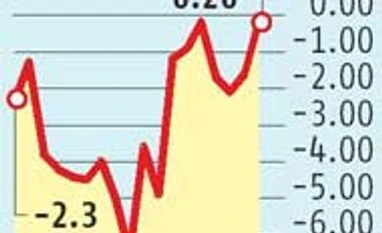
March quarter CAD falls to 0.2% of GDP
Sharply declines to $1.3 bn from $8.3 bn in the Dec quarter
BS Reporter Mumbai India’s current account deficit (CAD) declined sharply to $1.3 billion (0.2 per cent of gross domestic product) in the quarter ended March from $8.3 billion (1.6 per cent of GDP) in the quarter ended December.
The decline was due to a fall in gold imports and low average price of crude oil imports.
CAD for the quarter ended March of FY14 was $1.2 billion (0.2 per cent of GDP).
The Reserve Bank of India said the reduction in CAD in Q4 2014-15 was primarily due to lower trade deficit. The net earnings through services and primary income (profit, dividend & interest) witnessed a decline in a quarter-on-quarter basis.
Aditi Nayar, senior economist at Icra, said the sharp decline in CAD was because of a dip in gold import by about $3 billion. The average price of imported crude oil was less in January-March 2015 over October-December 2014.
Gross private transfer receipts, representing remittances by Indians employed overseas, amounted to $17.5 billion in the quarter, an increase of 1.2 per cent from year-ago period, it said.
Balance of payments (BoP) was in positive territory for the quarter. The addition to reserves was $30.2 billion in the quarter against $7.1 billion in the year-ago period, RBI said.
The accretion was almost four times of the reserves accrued in the fourth quarter of 2013-14, signifying a record increase in capital inflows and dip in CAD.
Rupa Rege Nitsure, group chief economist at L&T Finance Holdings, said the country attracted foreign portfolio and direct investments in the hope of future growth. Favourable external factors have also brought benefits. To sustain flows, there has to be improvement in the real sector of the economy, for which the government has continued with structural reforms and stepped up spending.
CAD for 2014-15 narrowed to $27.5 billion (1.3 per cent of GDP), compared to $32.4 billion (1.7 per cent of GDP) in 2013-14. India’s trade deficit declined to $144.2 billion in 2014-15 from $147.6 billion in 2013-14. There was modest increase in invisibles supported by some improvement in net services receipts, RBI said.
S K Ghosh, chief economic advisor at State Bank of India, said there was negative surprise with the CAD for FY15 higher than estimated at about $20 billion.
RBI has pegged the CAD for 2015-16 at 1.5 per cent.
The accretion to reserves for FY15 was pegged at $61.4 billion against $15.5 billion in FY14. On a cumulative basis, the overall BoP during FY15 showed improvement over the preceding year.
The lower CAD, on the back of contraction in trade deficit and marginal improvement in net invisible earnings, along with a sizable increase in net financial flows enabled a large build-up of reserves, RBI added.

 "March quarter CAD falls to 0.2% of GDP")


 Connect with us on WhatsApp