Demonetisation: Boon, bane, or simply brash?

'Business Standard' looks at its impact on the economy, banking system, companies and citizens
(Click on picture for details)
Ishan Bakshi New Delhi
Last Updated : Dec 31 2016 | 3:07 AM IST
DEMONETISATION: 50 DAYS LATER

The demonetisation of the Rs 500 and Rs 1,000 notes has been the most disruptive policy measure in several decades. Business Standard looks at its impact on the economy, banking system, companies, markets and citizens.  

When Prime Minister Narendra Modi announced that notes of Rs 500 and Rs 1,000 denomination would lose their status as legal tender on November 8, he did not have the comfort of an economy in the pink of health. 


The Gross Domestic Product (GDP) grew 7.3 per cent in the July-September 2016 quarter. But, beyond the headline number, growth was on a weak footing.  Gross Fixed Capital Formation had contracted for three straight quarters, with the pace of contraction actually accelerating. The capital goods segment in the index of industrial production (IIP), which connotes investment demand, had been contracting for more than a year. Similarly, export growth was lacklustre. After growing at 9.6 per cent in October, growth plummeted to a mere 2.3 per cent in November. Government spending is also likely to be curtailed as disinvestment receipts have been below the budgeted amount and spectrum auctions didn’t yield the expected bonanza. 


Given this scenario, all eyes were on a recovery led by consumption. A confluence of factors, working in tandem, were expected to prop up household demand beginning from the third quarter. First, after two back-to-back droughts, a good monsoon was expected to shore up rural incomes, propping up rural demand. Second, urban consumption was expected to get a fillip on account of proceeds from the Seventh Pay Commission. The resultant increase in demand was expected to boost industry’s capacity utilisation rates, triggering off fresh investments. A virtuous cycle would ensue. Or so it was hoped. 


Instead, the government’s decision to scrap roughly 86 per cent of the currency in circulation has ended up dealing a severe blow to the hopes of a consumption-led recovery. If anything, growth prospects are now bleaker. 

While it is difficult to accurately gauge the impact of this measure on growth, aggregate demand is expected to fall in the third and fourth quarters. The bigger worry is that its effects could linger well into the next financial year. Economists expect the decline in demand to compel firms to cut back production as inventory piles up. This will delay new investments. Firms were operating only at 72 per cent of their capacity, according to data from the Reserve Bank of India capacity utilisation survey in the April-June quarter. This is likely to decline further. 


“Small-and medium-scale enterprises are likely to face a prolonged period of distress,” says Madan Sabnavis, chief economist at CARE. Former Chief Statistician of India Pronab Sen concurs. “Small firms will suffer. Larger units are also under stress,” he says. 

Add to that, rise in the raw material prices and firms are likely to face severe margin compression. According to a report from Kotak Institutional Equities, prices of 65 per cent of the 40 basic raw materials they track are increasing. In some cases, the increase is in double digits. “The risks to margins are being underappreciated,” it says. 


As companies cut back production, demand for working capital loans is likely to fall, affecting bank revenues. “The banking sector is in a bad shape. While bank liabilities have increased, only a part has been parked in the Market Stabilisation Scheme bonds. They still have to pay interest on the rest. But credit has collapsed,” says Sen. 

The real worry now is the efficacy of policy levers to offset the impact of demonetisation. 

Monetary policy is one possible lever. While the Monetary Policy Committee erred on the side of caution in its December 7 meeting, analysts expect it to cut rates in February after the Union Budget. 


But, the ability of a rate cut to prop up demand in the short term is debatable. “Interest rates are only a facilitator. I don’t see demand for credit picking up until consumption demand picks up,” says Sabnavis.


Sen is even more circumspect about the efficacy of monetary policy in the current scenario. “Monetary policy is bust. The normal levers through which it operates changes in base money. But now you don’t have enough base money,” he says.

That leaves fiscal policy as the only game in town. The question: Does the government have enough fiscal room? Even if one assumes that the FRBM Committee does indeed provide the government with the space to boost spending, will it be enough? “Fiscal policy also has its limits. Increase in spending may not be large enough to turn things around,” says Sabnavis.


A possible way to shore up demand is to transfer the bounty from demonetisation, if there is one, to the poor. “While fiscal policy has its limitations, it could provide an immediate boost if there is a transfer to Jan Dhan accounts,” says Sen. He adds: “MNREGA is absolutely critical but it will work only if the central government gives assurances to state governments that funds will be disbursed.” 


Tinkering with tax rates to increase disposable income is another possibility. But, it’s difficult to predict its impact on boosting consumption in the short term, as people may simply use the extra room to shore up their precautionary savings. The going won’t be easy for some more time.


Agony Unlimited
 
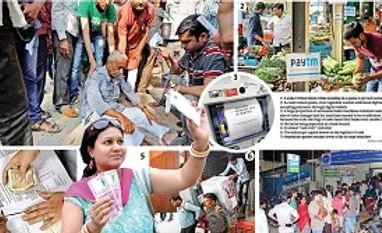
The biggest impact of the note ban was on the country’s citizens, who had to suffer a severe cash crunch as the pace of remonetisation remained slow.


(Click on picture for details)

*Subscribe to Business Standard digital and get complimentary access to The New York Times

Smart Quarterly

₹900

3 Months

₹300/Month

SAVE 25%

Smart Essential

₹2,700

1 Year

₹225/Month

SAVE 46%
*Complimentary New York Times access for the 2nd year will be given after 12 months

Super Saver

₹3,900

2 Years

₹162/Month

Subscribe

Renews automatically, cancel anytime

Here’s what’s included in our digital subscription plans

Exclusive premium stories online

  • Over 30 premium stories daily, handpicked by our editors

Complimentary Access to The New York Times

  • News, Games, Cooking, Audio, Wirecutter & The Athletic

Business Standard Epaper

  • Digital replica of our daily newspaper — with options to read, save, and share

Curated Newsletters

  • Insights on markets, finance, politics, tech, and more delivered to your inbox

Market Analysis & Investment Insights

  • In-depth market analysis & insights with access to The Smart Investor

Archives

  • Repository of articles and publications dating back to 1997

Ad-free Reading

  • Uninterrupted reading experience with no advertisements

Seamless Access Across All Devices

  • Access Business Standard across devices — mobile, tablet, or PC, via web or app

More From This Section

First Published: Dec 31 2016 | 3:07 AM IST

Next Story