ECB approvals to increase 38% over last year to $40 billion in FY19

The benchmark rate will be six-month dollar LIBOR or applicable benchmark for the respective currency
chart
Abhijit Lele Mumbai
Last Updated : Nov 02 2018 | 8:06 AM IST
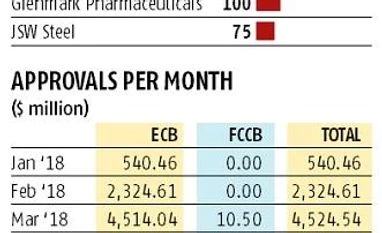
Approvals for External Commercial Borrowings (ECBs) in FY19 are expected to rise to $40 billion, from $29 billion in FY18, on relaxation in the limit on cost of funds, expanded list of borrowers, and the list of end use.

According to rating agency Icra, though overseas cost of borrowing is rising, they (costs) remain competitive to domestic cost of borrowing for corporates.

Amid risk aversion of domestic investors and tight liquidity conditions, companies have, of late, increasingly sought to raise funds through overseas borrowings. This is reflected in 62 per cent growth in ECB approvals to $16.5 billion in H1FY19, as compared to $10.2 billion during H1FY18. Growth in approvals has been driven by the Reserve Bank of India’s (RBI) relaxation of ECB guidelines during April 2018, whereby it increased the all-in cost of ECBs, expanded the list of eligible borrowers that included HFCs, and expanded the overall list of end-use for ECBs. With recent depreciation of the rupee, investors’ appetite for masala bonds has weakened and firms will have to raise borrowings in foreign currency. 

The aggregate funding cost of dollar-denominated ECBs continues to rise, driven by increase in LIBOR (London Inter-bank Offered Rate) rates, hedging costs, and reducing dollar liquidity. “Despite these challenges, the overall costing still remains competitive vis-a-vis domestic sources. ECB approvals are expected to increase to $35-40 billion during FY19 from $28.9 billion in FY18. This is on the back of ongoing trends and various measures taken by the RBI, including borrowing of $10 billion permitted to oil marketing companies,” said Karthik Srinivasan, Group Head (Financial Sector Rating), Icra. In April this year, the RBI further liberalised its ECB policy to facilitate cheaper access of overseas funds. 

The benchmark rate will be six-month dollar LIBOR or applicable benchmark for the respective currency. The RBI also permitted housing finance companies and Port Trust to avail of ECBs under all tracks. Bankers said an increase in ECB money will help bridge the deficit on current account and balance of payments.

India’s current account deficit stood at $15.8 billion (2.4 per cent of GDP) in Q1FY19 as compared with $15 billion (2.5 per cent of GDP) in Q1 FY18. The rise was due to a higher trade deficit. In Q1 FY19, there was depletion of $11.3 billion in foreign exchange reserves, on a BOP basis, as against an accretion of $11.4 billion in Q1FY18. 

One subscription. Two world-class reads.

Already subscribed? Log in

Subscribe to read the full story →
*Subscribe to Business Standard digital and get complimentary access to The New York Times

Smart Quarterly

₹900

3 Months

₹300/Month

SAVE 25%

Smart Essential

₹2,700

1 Year

₹225/Month

SAVE 46%
*Complimentary New York Times access for the 2nd year will be given after 12 months

Super Saver

₹3,900

2 Years

₹162/Month

Subscribe

Renews automatically, cancel anytime

Here’s what’s included in our digital subscription plans

Exclusive premium stories online

  • Over 30 premium stories daily, handpicked by our editors

Complimentary Access to The New York Times

  • News, Games, Cooking, Audio, Wirecutter & The Athletic

Business Standard Epaper

  • Digital replica of our daily newspaper — with options to read, save, and share

Curated Newsletters

  • Insights on markets, finance, politics, tech, and more delivered to your inbox

Market Analysis & Investment Insights

  • In-depth market analysis & insights with access to The Smart Investor

Archives

  • Repository of articles and publications dating back to 1997

Ad-free Reading

  • Uninterrupted reading experience with no advertisements

Seamless Access Across All Devices

  • Access Business Standard across devices — mobile, tablet, or PC, via web or app

Next Story


