Economists urge FM Sitharaman to set realistic fiscal deficit target

The economists also said the tax revenue targets for 2019-20 were unrealistic and should be revised to more achievable levels
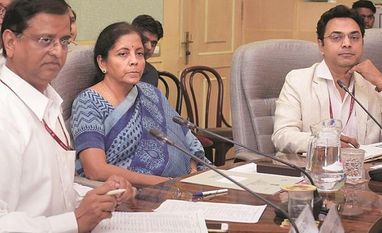
Nirmala Sitharaman
In the meeting with Sitharaman (centre) on Friday, economists suggested preparing of a comprehensive paper on GDP data. Photo: PTI
Arup Roychoudhury New Delhi
4 min read Last Updated : Jun 21 2019 | 7:55 PM IST
The government should come up with a realistic, achievable fiscal deficit target that can be achieved without resorting to off-budget financing, and should release a comprehensive working paper on the methodology of gross domestic product data and other economic indicators to quell the issues of credibility around official statistics.

These were some of the suggestions given by economists and policy experts who met Finance Minister Nirmala Sitharaman and senior ministry officials for pre-Budget consultations on Friday evening, Business Standard has learnt.

The economists also said the tax revenue targets for 2019-20 were unrealistic and should be revised to more achievable levels, and that the government should prepare a statement of intent for its social, rural and welfare sector expenditure with the Budget, wherein it should detail all the allocation and achievements in the sectors and its future plans, said a person who attended the meeting.

There were concerns on the GDP growth slowdown, and the economists spoke of the need to implement long-term structural steps like land and labour reforms. There were also suggestions for the government to shift to accrual-based budgeting from cash-based budgeting.

“The discussion was around how given the constraints on the revenue side of things, the government can afford to give itself some fiscal breathing space and expand the target for the year, as long as there is transparency and off-Budget financing is not resorted to,” the person said.

As reported earlier, when Sitharaman presents her first Union Budget in Lok Sabha on July 5, she is highly likely to forecast a fiscal deficit target for 2019-20 at 3.4 per cent of GDP. This target will be retained from the 2019-20 interim Budget, presented on February 1. 

Figures given in the 2019-20 interim Budget showed that corporate tax collections would be higher by 15 per cent in 2019-20 over actual collections in 2018-19 and that personal income tax collections would increase by an even greater proportion — 34 per cent. The Central Board of Direct Taxes has asked for a reduction of the target as growth is wavering. Goods and services tax collection, closely related to the health of the economy, is projected to increase by 31 per cent in the interim Budget for 2019-20 over actual collections in 2018-19.

The economists gathered also spoke about the debate raging around the credibility of official government statistics, including the recent paper by former Chief Economic Advisor Arvind Subramanian. Earlier this week, Subramanian had said he had analysed data on 17 economic indicators in the real sector, and concluded that India’s real GDP growth “was more likely to have been between 3.5 and 5.5 per cent” in the 2011-2016 period, rather than 6.9 per cent, as estimated by the National Statistical Office (NSO). He said the new GDP series overestimated real GDP growth by 2.5 percentage points.

“There were suggestions for a comprehensive white paper by the government, explaining the revision of methodology and the economic indicators, which are taken into account while calculating GDP data,” the person said.

A statement issued by the finance ministry after the meeting said the main areas of discussion during the meeting included boosting economic growth, job creation, fiscal management including ideal size of public sector borrowing requirements and increase in investments among others.

The economists and experts who attended the meeting included Rathin Roy, director of National Institute of Public Finance and Policy and member of Economic Advisory Council to the Prime Minister, former Reserve Bank deputy governor Rakesh Mohan, former CEAs Arvind Virmani and Nitin Desai, Mahendra Dev, vice-chancellor of Indira Gandhi Institute of Development Research, Surjit Bhalla, Soumya Kanti Ghosh, chief economist of State Bank of India, Errol D’ Souza, professor at Indian Institute of Management, Ajit Ranade, chief economist of Aditya Birla Group and others.

From the government’s side, along with Sitharaman, the meeting was attended by NITI Aayog Vice-Chairman Rajiv Kumar, Finance Secretary Subhash Garg, Revenue Secretary Ajay Bhushan Pandey, Financial Services Secretary Rajiv Kumar, Expenditure Secretary Girish Chandra Murmu, DIPAM Secretary Atanu Chakraborty, CEA Krishnamurthy Subramanian, and other senior officials.

One subscription. Two world-class reads.

Already subscribed? Log in

Subscribe to read the full story →
*Subscribe to Business Standard digital and get complimentary access to The New York Times

Smart Quarterly

₹900

3 Months

₹300/Month

SAVE 25%

Smart Essential

₹2,700

1 Year

₹225/Month

SAVE 46%
*Complimentary New York Times access for the 2nd year will be given after 12 months

Super Saver

₹3,900

2 Years

₹162/Month

Subscribe

Renews automatically, cancel anytime

Here’s what’s included in our digital subscription plans

Exclusive premium stories online

  • Over 30 premium stories daily, handpicked by our editors

Complimentary Access to The New York Times

  • News, Games, Cooking, Audio, Wirecutter & The Athletic

Business Standard Epaper

  • Digital replica of our daily newspaper — with options to read, save, and share

Curated Newsletters

  • Insights on markets, finance, politics, tech, and more delivered to your inbox

Market Analysis & Investment Insights

  • In-depth market analysis & insights with access to The Smart Investor

Archives

  • Repository of articles and publications dating back to 1997

Ad-free Reading

  • Uninterrupted reading experience with no advertisements

Seamless Access Across All Devices

  • Access Business Standard across devices — mobile, tablet, or PC, via web or app

Next Story


