El Nino to reappear? India braces for Met monsoon forecast

The southwest monsoon provides a little more than 70% of the country's annual precipitation
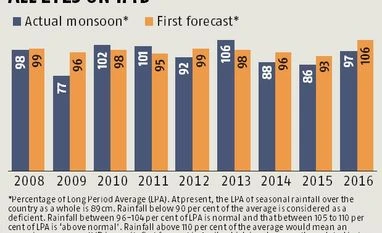
Chart
Chart
Sanjeeb Mukherjee New Delhi
Last Updated : Apr 17 2017 | 12:58 PM IST
This week, many eyes would be on the large red building on Lodhi Road here that houses the headquarters of India Meteorological Department (IMD).

On schedule is its first forecast on the 2017 southwest monsoon, an annual event that sets the tone not only for agricultural production but also the manner in which the economy, stock markets, inflation and interest rates would move in the year.

The impact of a failed monsoon is not as severe as was the case in the past. Even so, the June-to-September rains are vital for farming. Less than half of arable land in the country is under canal irrigation. The southwest monsoon provides a little more than 70 per cent of the country’s annual precipitation.

Private weather forecasters, led by Skymet, predict slightly less than average rain for 2017,  with the El Niño weather phenomenon again playing a key role. An El Niño  is characterised by gradual warming of the sea surface temperature along the equatorial Pacific Ocean. It has an overbearing impact on the Indian rains and 80 per cent of El Niño years has seen a below-normal monsoon; 60 per cent have been outright drought years.

Till mid-December, the oceans were in a neutral state. In 2017, they’ve started heating, the first indication of an El Niño   reappearance. Weather watchers are keeping their figures crossed and have predicted a 50:50 chance of an El Niño this year.

The IMD’s latest report on this, in end-March said in June-August, the sea surface temperature anomaly was expected to cross the El Niño threshold of 0.5 degrees Celsius. This typically should mean the weather phenomenon would be in an evolving stage during the peak monsoon months.

IMD chief K J Ramesh had told this newspaper some weeks earlier that an El Niño  would not be present during the monsoon development stage. However, some private weather forecasters believe  an evolving El Niño  can be as bad as a full-blown one. This had happened in 2014, when an evolving El Niño pulled monsoon rain down to 12 per cent below the normal.

A reassuring factor is the Indian Ocean Dipole (IOD), another of the factors that has a bearing on the southwest monsoon. It is expected to remain neutral during the four-month southwest monsoon. Some weather scientists believe that in the absence of a clear picture on El Niño, this would be a vital factor in determining the rains. An IOD is defined as an irregular oscillation of sea-surface temperatures, in which the western Indian Ocean becomes alternately warmer and then colder than the eastern part. There are also other factors which determine the southwest monsoon. Whether these combine to generate a normal one in 2017 would be clearer in the next few days.


One subscription. Two world-class reads.

Already subscribed? Log in

Subscribe to read the full story →
*Subscribe to Business Standard digital and get complimentary access to The New York Times

Smart Quarterly

₹900

3 Months

₹300/Month

SAVE 25%

Smart Essential

₹2,700

1 Year

₹225/Month

SAVE 46%
*Complimentary New York Times access for the 2nd year will be given after 12 months

Super Saver

₹3,900

2 Years

₹162/Month

Subscribe

Renews automatically, cancel anytime

Here’s what’s included in our digital subscription plans

Exclusive premium stories online

  • Over 30 premium stories daily, handpicked by our editors

Complimentary Access to The New York Times

  • News, Games, Cooking, Audio, Wirecutter & The Athletic

Business Standard Epaper

  • Digital replica of our daily newspaper — with options to read, save, and share

Curated Newsletters

  • Insights on markets, finance, politics, tech, and more delivered to your inbox

Market Analysis & Investment Insights

  • In-depth market analysis & insights with access to The Smart Investor

Archives

  • Repository of articles and publications dating back to 1997

Ad-free Reading

  • Uninterrupted reading experience with no advertisements

Seamless Access Across All Devices

  • Access Business Standard across devices — mobile, tablet, or PC, via web or app

Next Story


