Expansionary monetary policies in advanced nations helped curb global recession: Takehiko Nakao
Interview with President, ADB
Business Standard Recently, Manila-based Asian Development Bank (ADB) confirmed the appointment of Japan's vice-minister of finance for international affairs,
Takehiko Nakao, as its new president. Takao replaced Haruhiko Kuroda, who had, in March, quit ADB to take charge as Japan's central bank governor. Since ADB was founded in 1966, all its presidents have been Japanese. In his first annual meeting of the ADB board of governors after taking charge of the multilateral lending agency, Nakao said poverty reduction and sustainable growth in middle-income countries would be his priorities. Edited excerpts:
On the growth outlook for Asia and the world: Growth in Asia has been more robust after the Lehman crisis. At that time, there was a discussion on decoupling Asian growth from the rest of the world. It was because of domestic demand that countries such as India and China grew, and this would continue to be the case, as Asia has strong domestic demand and robust production capacities. Advanced economies would grow at a slower pace than they did during the Lehman crisis.
On the impact of quantitative easing and expansionary monetary policies: Monetary policies in advanced economies such as Japan have been expansionary and groupings such as the G-20 have been mindful of this. Signs of a negative spillover of this into emerging economies are more limited than thought earlier. If an expansionary monetary policy leads to inflows into emerging countries, it is welcome. If there is a bubble in assets, countries can manage those inflows. More importantly, I feel if advanced economies didn't have expansionary monetary policies, the global recession would have been worse. Expansionary monetary policies in advanced countries had their benefits.
On lending to India:
We would like to continue to lend at high levels to India. We have no solid base of capital to continue to lend at levels higher than before. Of course, there are challenges to maintain these levels of lending. Because our income from investments of surplus resources is mostly lent to European countries, the return on investment is lower than expected, owing to low interest rates. We hope to solve the issue of maintaining a sustainable lending level.
On the BRICS (Brazil, Russia, India, China and South Africa) bank and its relevance:
We can support the BRICS bank if necessary.... We don't have to change our business model because of the BRICS bank…. The banking business is difficult, as it involves finding good projects, lending, monitoring repayment of loans, etc. At this moment, we don't see it as a challenge. There are many ways to support infrastructure; one way is to channel domestic savings in more productive ways.
On his priorities after taking charge:
My priorities are poverty reduction and sustainable growth in middle-income countries. We would also like to continue our assistance to social sectors.
I believe growth in infrastructure not only helps economic growth, but also reduces poverty. This is because without transport, roads, etc, access to health and other social services by the poor is limited. We need about $8 trillion to develop infrastructure in Asian nations, but our options are limited. We would like governments to mobilise resources for infrastructure, through various means. ADB can play the role of a catalyst in mobilising offshore money for infrastructure. In India, there are many good infrastructure projects such as the Delhi-Mumbai Industrial Corridor. We would also like to continue our assistance to social sectors such as health, education, gender equality, etc.
On the impact of the depreciation of the yen:
I think the depreciation of the yen was needed to get out of chronic deflation. The Japanese yen had appreciated sharply after the Lehman crisis. Therefore, it might be correcting itself.
The depreciation of the yen is also a reflection of the global financial conditions.
On Japan having a virtual monopoly on ADB presidentship:
We have always said we want to have an open and transparent system to select ADB presidents. We do not have any problem if any other contender comes. But once I became a candidate for president, there was no other contender. However, after my selection, I met the representatives of many countries and they welcomed by selection.

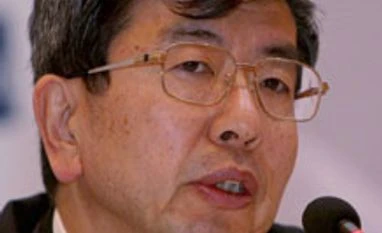 "Expansionary monetary policies in advanced nations helped curb global recession: Takehiko Nakao")

