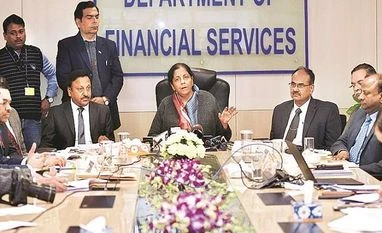
Days after Prime Minister Narendra Modi asked lenders to take loan decisions without fear, the finance ministry on Saturday tried to allay apprehensions of public sector banks (PSBs) related to investigative agencies by bringing the brass of PSBs and the Central Bureau of Investigation (CBI) to the same table.
After the meeting, Finance Minister Nirmala Sitharaman said the CBI would ensure that all the notices sent by it to bankers carried a director identification number (DIN), as is being done by the income-tax (I-T) department. This, she said, would remove the possibility of unauthorised communication “and consequent harassment”, which was a cause of concern for bankers.
Sitharaman said the CBI brass tried to clear the “misgivings and apprehensions” in the bankers’ minds. “In the recent past, banks have gone through a worrying period, when decision-making became difficult. They were worried about three Cs — the CBI, CVC (Central Vigilance Commission), and CAG (Comptroller and Auditor General of India). There was concern that there would be undue harassment even if decisions were genuine and bona fide,” she told reporters.
The finance minister will chair similar meetings of bankers and officials of the Directorate of Revenue Intelligence and the Enforcement Directorate.
The meeting of bankers with the finance ministry, the Reserve Bank of India (RBI), and the CBI came days after the prime minister and the finance minister asked banks to take decisions fearlessly. The PM, at an event in the national capital, had assured India Inc and bankers that no action would be initiated if genuine commercial decisions turned bad.
Sitharaman said CBI officials told bankers that any fraudulent activities did not automatically mean that the bank staff was involved in those.
To probe on prima facie evidence, the CBI needs the permission of banks. “The CBI does not take up cases of bank frauds until lenders decide to send them to the agency,” she said.
There is an arrangement that any fraudulent activity of above Rs 3 crore will be first checked by an internal committee of the bank concerned. Only when the matter is informed to the Reserve Bank of India, the reference will be made to the CBI, she said.
CBI Director Rishi Kumar Shukla will hold a separate meeting and workshops with public sector bankers to explain the investigation procedure in detail and the roles that they have to play in it.
The FM further said banks should not sit on old cases, and directed them to form general manager-led committees to expedite the pending cases. “Vigilances cases of the past have accumulated over several years. We have given a clear instruction to banks to go back to GM-level committees and look at the pending vigilance cases. They should either pursue them or close them expeditiously,” Sitharaman said.
While pursuing criminal action against those responsible, the CBI will be sensitive to the distinction between genuine commercial failures and culpability. It was also noted that there was a need for preserving the value of the business enterprise by treating it on a separate footing from culpability of individuals, the finance ministry later said in a statement.
A press release issued by the ministry said banks were advised to devise standard operating procedures for carrying out forensic audit. The Indian Banks’ Association has been told to tie up with the CBI for training forensic auditors, put in place “robust arrangements for assessing adherence to standards by forensic auditors”, and strengthen the forensic auditor empanelment process.

 "FM directs CBI to use director identification number in notices to bankers")











