Even though the health care sector is exempt from the goods and services tax (GST), hospitalisation costs are estimated to go up by four to five per cent under the new indirect tax regime, said Prathap C Reddy, founder-chairman, Apollo Hospitals. Indicating that hospitalisation costs are likely to go up after the introduction of GST, Reddy said hospitals could bear the brunt of GST up to two per cent. “Anything beyond that we would have to pass it on to patients,” he said.
The cause behind a probable rise in costs maybe a higher tax rate on certain ancillary medical procedures and products, such as dialysis, blood tests, X-rays, ranging anywhere between 12-18 per cent. Further, there is a lack of clarity among hospitals whether they will be able to claim input tax credit on medical equipment. Also, some medicines have become more expensive under the GST regime.
Reddy said higher tax on ancillary services is pushing up the price impact on health care. In the pre-GST regime, all taxes put together were around 16.5 per cent for diagnostics. Interestingly, furniture for hospital use like beds, dentist’s chair and operating table fall under the 18 per cent GST slab.
In its recent meeting, the GST Council revised the rates for strip-based diagnostics (reagents) to 12 per cent. The domestic medical devices industry has recently represented to the government, asking for a reduction in rates for all diagnostics that include analysers. Some of the services like dialysis, fall in the 12 per cent category under the GST regime. This is opposed to the rate of 5 per cent previously.
They have asked the government to consider ultrasound scanners in the five per cent bracket. Tax experts expect GST to streamline the taxation structure in the pharmaceutical sector, which currently attracts eight different types of taxes. However, input tax credit and an overall reduction in transaction costs are expected to work in favour of the pharmaceutical industry.
Among other issues, Reddy stated that the effect of price capping of stents is backfiring on India. One of the effects of price control on stents has been a shortage of high-end stents, said Reddy. This is despite the National Pharmaceutical Pricing Authority’s (NPPA) order to stent companies to maintain the availability of high-end stents such as Abbott’s Absorb and Xience Alpine, among others.
Though Reddy in-principle supported government's move to cap the pricing of stents, he was of the view that the NPPA should have attempted a differential pricing pattern, while fixing the price of stents.
Reddy felt that one of the reasons that may have triggered this action by the government was that many companies brought down the price of high-end stents in Europe by almost 40 per cent. However, the price cut was not passed on to India. “That is the reason I believe the government did the right thing by capping the price of coronary stents,” he said.
The NPPA capped the price of all drug-eluting stents to around Rs 30,000, much to the chagrin of the multinational stentmakers such as Abbott, Medtronic and Boston Scientific.

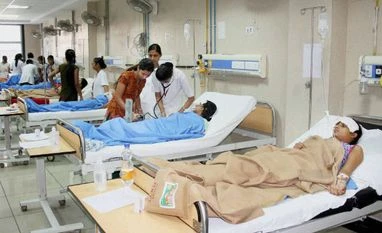 "Hospitals can bear up to 2% hike in costs due to GST: Apollo Hospitals")











