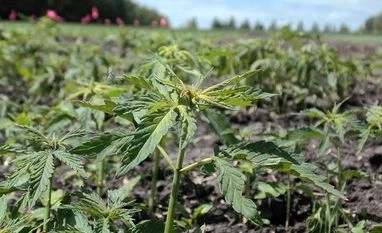
Can a crop give as much as 600 per cent return on investment in this country? That might sound completely out of place, especially as the prices of almost all farm commodities have crashed in the past few years.
But, that may indeed become a reality, if industry players are to be believed. The cultivation of hemp (cannabis sativa) with low psychoactive component tetrahydrocannabinol (THC) (less than 0.3 per cent), purely for industrial purposes, might be on the cards.
Cannabis used as a drug and that for the industrial purpose are both derived from the same cannabis sativa species. But each has distinct and unique phytochemical composition. Industrial hemp has lower THC and higher cannabidiol (CBD) concentrations which decrease or eliminate its psychoactive effects. The most commonly available variety of cannabis, though, has a high THC concentration.
It is the low THC variety of hemp that has a high demand, given its multi-purpose use in various industries. Almost all parts of such plants – stem, leaves, flower, even seeds – are used by industries. However, since it is a highly regulated field, legal cultivation of hemp with low THC content has hardly grown in India.
The Narcotic Drugs and Psychotropic Substances Act, 1985 (NDPS Act) allows the central government to permit cultivation of cannabis, exclusively for horticulture and industrial purposes. But problems with proper testing of the psychoactive component and the absence of technically backed standards have also prevented cultivation.
“The central government shall encourage research and trials of cannabis cultivars with low THC content. It (the Centre) shall, however, follow a cautious, evidence-based approach towards cultivation of cannabis for horticultural and/or industrial purposes and shall take decisions based on results of research," the NDPS Act says.
The Act prohibited the cultivation of other forms of cannabis, but empowered the respective state governments to allow cultivation of cannabis to be used as bhang for local and medicinal usage.
“States weren’t keen to encourage its cultivation for industrial use as in the absence of proper standards to distinguish industrial hemp from that used as a drug. But the India Industrial Hemp Association (IIHA) has since 2012 worked closely with the Sriram Institute for Industrial Research, Bengaluru, to develop standards and testing manuals for distinguishing industrial-use hemps from other cannabis varieties,” IIHA President Rohit Sharma told Business Standard.
Sharma said the average cost of cultivation of industrial-grade hemp was around Rs 60,000 per acre, according to their studies. The returns from the crop could be between Rs 200,000-250,000 per acre, even if the flowers of the plant (with which marijuana is made) are not allowed to be sold.
This unimaginable return on investment, according to Sharma, is mainly because of the huge demand for industrial hemp as fibre, cosmetics and medicines, for making MDF plyboards, and also for use by the construction industry.
“For hemp fibre alone, there is an annual demand of over 150,000 tonnes. In the absence of domestic availability, we have to import it from China,” Sharma said.
IIHA on Tuesday said that it had received a licence to cultivate industrial hemp, the first one in India in 33 years. The Uttarakhand government issued the licence for the launch of a pilot to promote the cultivation of industrial hemp in the Pauri Garhwal district, IIHA said in a statement.
Uttarakhand is among the first Indian states to legalise industrial hemp cultivation. Just as licences are issued for cultivation of opium in Madhya Pradesh, it can be done for cannabis as well.
The most common form of hemp for industrial use is the fibre extracted from the stem of the plant after peeling the outer layer. Just as in jute, the threads that make the stem of the plant are processed to create a soft but extremely strong and resilient fibre.
The plant’s seeds are used as food, while the oil extracted from it has high OMEGA fatty acids, which help reduce cholesterol and are good for the heart. The flowers of hemp have medicinal values as well and are increasingly being preferred by doctors to treat diseases like epilepsy and cancer, and as an anti-inflammatory agent instead of morphine.
“It is incorrect that all forms of cannabis are used for drugs. In reality, there is a lot of other ways of use as well,” Sharma said. In India, cannabis has been cultivated for ages; the most common form of its consumption is as bhang, extracted from the leaves and buds of the plant. Bhang has been used in Ayurvedic and Unani medicines mostly as a pain reliever.
That apart, the NDPS Act also banned other drug forms like hashish, ganja and charas, extracted from flower, fruiting tops and resins of the cannabis plant. But, with its growing industrial use, the hemp association has started discussions with the state governments of Madhya Pradesh, Jharkhand and Himachal Pradesh to allow legal cultivation of cannabis with low THC content, mainly for industrial use.
- Legal Hemp cultivation for industrial use can boost farm incomes
- India prohibits cultivation of cannabis, but allows its growing under NDPS Act for horticulture and industrial use.
- Cannabis is mostly used as bhang in India but these varieties have high THC content.
- Low THC content cannabis is used for industrial purposes and the most common form is fiber.
- The hilly states of Uttarakhand, Himachal Pradesh reportedly have the biggest concentration of cannabis plant in India.