How onions and pulses could wreck the Centre's food inflation arithmetic

Damage to standing crops due to extended rain, depletion of stocks at home and in global markets could spoil the calculations
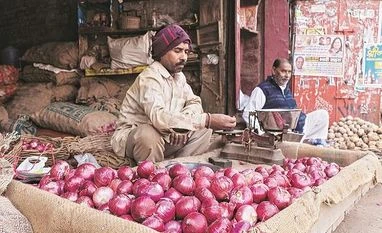
Onion, onion prices
Sanjeeb Mukherjee New Delhi
9 min read Last Updated : Nov 04 2020 | 4:46 PM IST
While both the Centre and the Reserve Bank of India (RBI) remain optimistic about a fall in retail inflation during the coming weeks due to the bumper Kharif harvest and the steps taken to ease the price situation, two items namely, onions and pulses, could prove to be spoke in the wheel in the government's inflation calculations.

However, to what extent the price rise benefits the farmers is a million-dollar question. This is because studies show that if there is a perfect transmission to them from consumers, a 10 per cent increase in the price realised by farmers directly raises their incomes by 13 per cent and has a large favourable effect on production as well.

Onion prices, which have steadily risen the past few months largely due to the damage to the standing crops, could see a moderation the next few weeks due to higher imports and the arrival of new harvest from Rajasthan, Karnataka and Maharashtra. But some market watchers feel the moderation may not be big enough for prices to crash.

“Till the next rabi harvest comes to the markets sometime in late February and early March, onion prices will not crash, though there will be some moderation,” said a senior official who has been closely tracking the sector.

In the case of pulses too, trade sources said chana prices might remain elevated for some time as there are simply no stocks in the domestic and global market, while in the case of urad, the damage to standing crops in Karnataka due to extended southwest monsoon could keep prices at a higher trajectory.

That said, there might be some moderation in prices due to imports, but trade sources said how long and sustained that will be remains to be seen.

Government’s belief

The Economic Affairs Secretary recently said high food prices are a temporary phenomenon and the situation should be back to normal soon with the arrival of new crops and government steps to improve the supply of essentials.

Pushed by rising prices of essential kitchen items, retail inflation rose to an eight-month high of 7.34 per cent in September.

Consumer Price Index (CPI)-based inflation was 6.69 per cent in August and 3.99 per cent in September 2019.

The inflation has been hovering above 4 per cent since October 2019.

The previous high in the CPI was 7.59 per cent in January 2020. Wholesale Price Index (WPI)-based inflation rose to 1.32 per cent this September, mainly on the back of costlier food articles.

A few weeks back, RBI Governor Shaktikant Das too had said that retail inflation is expected to remain close to the targeted level by the last quarter of the current fiscal year (2020-21).

The RBI has kept the retail inflation target of four per cent, with a bias of plus or minus two per cent.

The pulses basket

In the pulses basket trade sources said that chana prices will remain above MSP levels of Rs 5,100 a quintal for the next few months as there are simply very few stocks in the market.

The next domestic chana crop will come around February, while the country needs around 0.7-0.8 million tonnes of the produce every month. This means that till February, India will need around 2.5-2.8 million tonnes of chana.

Traders said unless import duty is immediately lowered to below 30 per cent from the current 60 per cent, prices won’t come down as there are simply no pipeline stocks of chana both with state agency Nafed and private traders.

“Whatever, stocks are left with Nafed, will have to be exhausted through the Garib Kalyan Scheme, if it is extended beyond November,” a senior pulses trader said.

He said even if the duty is reduced, moderation in prices will be limited as globally too there isn’t much chana available.

However, the government sources said it is not keen to lower the import duty as it will send a wrong signal to farmers who are sowing the country’s biggest pulse crop at present, in largely rainfed areas of Madhya Pradesh, UP, Rajasthan and Maharashtra.

Traders on the other hand said that even if the duty is lowered, only 700,000-800,000 of chana can come, that too from Australia as the new crop is getting harvested there from November.

Australia used to produce some two million tonnes of chana entirely for the Indian market, but in the past few years its production fell due to drought and higher Indian output. But this year, its production has risen.

Tur is another pulses whose prices have jumped the past few months. Government sources are saying that production this year is expected to be about 3.8 million tonnes and consumption at around 4.0 million tonnes.

Therefore, the difference has to be made through import, which was recently allowed by the government in limited quantities and as a result of which prices moderated a bit. But traders said unless the new crop comes in December, prices will remain higher.

In the case of urad too, heavy late rains in Maharashtra and Karnataka have damaged almost 10 per cent of the standing crop.

While the government expects urad production to be around 2.1 million tonnes this kharif season, trade sources said prices will remain higher due to damage to standing crops.

“Till February when the new urad crop comes in Myanmar, prices might remain at above MSP of Rs 6,000 per quintal,” another trader said.

Urad has a weight of 0.27 per cent in retail inflation, while the overall food and beverages have a weight of almost 46 per cent. Tur has a weight of 0.79 per cent, gram (chana)-whole has a weight of 0.09 per cent and Gram (split), 0.19 per cent. 

Onions

Onion is cultivated thrice in a year in India --Rabi (March-May), Kharif (October-December) and late Kharif (January-March).

The kharif harvest of onions fills the gap between rabi and late kharif and is among the most susceptible to climate vagaries.

Kharif onions account for almost around 20 per cent of the country’s annual onion production of 21-24 million tonnes, but are vitally important as they are harvested during the lean months and an even a slight drop in output can put the retail markets in a tizzy. This is something that happened this year in the main growing regions of Maharashtra, Karnataka and Telangana.

The biggest onion crop is harvested during the rabi season in the months of March to May, and is stored to last till October.

India usually stores around 5.0-5.5 million tonnes of rabi onions that last till from June to October as the country’s monthly consumption of onions is around 1.2-1.5 million tonnes.

Thereafter, between September-end and early October, the kharif harvest starts hitting the market. But this year, due to the unprecedented rains, the crop got damaged and supplies were hampered leading to spurt in prices, which has been exploited by traders to the hilt.

Officials said kharif onion production this year is projected to be around 3.7 million tonnes, which is around 14 per cent less than last year’s kharif onion output.

State-run Nafed, which held around 100,000 tonnes of onions that it had purchased for the past few months, is also fast running out of its inventories because it has already sold around 42,000-43,000 tonnes since March, while about a quarter of the stocks has been damaged, which is the norm.

“Onions can be stored in good condition for 3.5-4 months, therefore this damage is normal,“ another senior official said. He added that the stocks Nafed is liquidating in a calibrated manner will last till early November.

“The rains have also impacted planting of the next onion crop (the late kharif), which is why traders are exploiting the situation to jack up prices and rates might moderate for a while after the new harvest comes, but prices won’t crash as the harvest is on the lower side,” the official explained.

Onions have a weight of 0.64 in Retail Inflation while the overall food and beverages have a weight of almost 46 per cent in CPI.

Steps taken

To cool down prices, the Central government has recently taken a number of steps such as higher imports of onions, potatoes and pulses.

A few days back, consumer affairs minister Piyush Goyal said India is planning to import 25,000 tonnes of onions and 30,000 tonnes of potatoesm and has relaxed the norms for import of pulses to tide over the spurt in prices.

In the case of onions, the minister said that around 7,000 tonnes have already been imported from various countries, while another tranche of 25,000 tonnes is expected to arrive before Diwali. Orders have also been placed for import of 30,000 tonnes of potatoes from Bhutan, which will arrive in the next few days.

In total, there are plans to import around a million tonnes of potatoes in the next few weeks to cool down prices.

For pulses, the government said thixat the timeline for import of 0.4 million tonnes of tur under the tariff rate quota has been extended till December 31, while the 10 per cent lower import duty on masur will continue during that period.

That apart, the Centre has extended the understanding with Mozambique to import 200,000 tonnes of tur each year and with Myanmar for 250,000 tonnes of urad each year for another five years to provide long-term stability to prices. 
Weights in CPI (combined)

Food and beverages: 46 per cent 

Vegetables: 6.04 per cent 

Pulses and Products: 2.38 per cent 

Source: Government of India 

One subscription. Two world-class reads.

Already subscribed? Log in

Subscribe to read the full story →
*Subscribe to Business Standard digital and get complimentary access to The New York Times

Smart Quarterly

₹900

3 Months

₹300/Month

SAVE 25%

Smart Essential

₹2,700

1 Year

₹225/Month

SAVE 46%
*Complimentary New York Times access for the 2nd year will be given after 12 months

Super Saver

₹3,900

2 Years

₹162/Month

Subscribe

Renews automatically, cancel anytime

Here’s what’s included in our digital subscription plans

Exclusive premium stories online

  • Over 30 premium stories daily, handpicked by our editors

Complimentary Access to The New York Times

  • News, Games, Cooking, Audio, Wirecutter & The Athletic

Business Standard Epaper

  • Digital replica of our daily newspaper — with options to read, save, and share

Curated Newsletters

  • Insights on markets, finance, politics, tech, and more delivered to your inbox

Market Analysis & Investment Insights

  • In-depth market analysis & insights with access to The Smart Investor

Archives

  • Repository of articles and publications dating back to 1997

Ad-free Reading

  • Uninterrupted reading experience with no advertisements

Seamless Access Across All Devices

  • Access Business Standard across devices — mobile, tablet, or PC, via web or app

Topics :Wholesale food inflationfood inflationonion pricepulses

Next Story



