IMF, WB unduly pessimistic; growth to exceed 5%: Rangarajan
World Bank slashed India's economic growth forecast for the current financial year to 4.7% , IMF to 3.75%
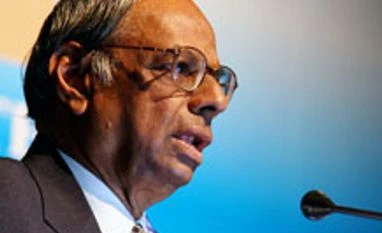
Press Trust of India New Delhi Rejecting IMF and World Bank's "unduly" pessimistic projections, Prime Minister's key economic advisory council chairman C Rangarajan today exuded confidence that the growth would be around 5.5% in the current fiscal.
"These institutions are unduly pessimistic. We think the growth rate will be between 5 and 5.5%. We have projected growth rate of 5% earlier, which I think still holds," Rangarajan said on the sidelines of Global Conference on Financial Inclusion & Payment System here.
Earlier this month, the World Bank slashed India's economic growth forecast for the current financial year to 4.7% from an earlier projection of 6.1%.
Meanwhile, International Monetary Fund (IMF), in its World Economic Outlook, projected an average growth rate of about 3.75%, based on market prices, for India in 2013-14, that is expected to pick up to 5.1% next fiscal.
Last month, the Prime Minister's Economic Advisory Council (PMEAC) had lowered the growth forecast for the current financial year to 5.3% from 6.4% it had projected earlier.
Rangarajan said agriculture will do extremely well. "Monsoon has been extremely good. This will result in pick up the rural demand.
"As far as manufacturing is concerned, second half will show a definite improvement. We will see the impact of measures introduced in last five to six months. There will also be a strong pick up in manufacturing in second half. Therefore, we still stand by our earlier forecast," he said.
"Indications are exports are picking up in August and September. In August and September export growth rate was double digit. That will also have an impact on domestic production, he added.
On financial inclusion, Rangarajan said the government should look at the idea of local area bank.
"While I had given the idea a few years ago, only a few such banks operate now. There is a need to relook at the idea again," he said.
"Banks are in the best position to lead financial inclusion. They have just got more teeth from the banking correspondent model and a sharper focus on self-help groups," he said.

 "IMF, WB unduly pessimistic; growth to exceed 5%: Rangarajan")


 Connect with us on WhatsApp