India and China announce end of Doklam standoff

Big win for India that will enhance its status with South Asian neighbours
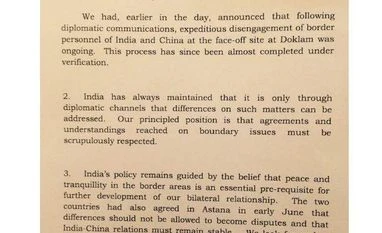
MEA
A release issued of Ministry of External Affairs
Ajai Shukla
Last Updated : Aug 28 2017 | 6:58 PM IST
The 71-day military standoff at Doklam, on the tri-junction of the Indian, Chinese and Bhutanese borders, has been defused without armed confrontation and bloodshed.

In a coordinated announcement on Monday, the Indian and Chinese foreign ministries both announced that troops were disengaging at the Doklam bowl, where they have been in eyeball-to-eyeball contact since June 16, when the Indian Army moved hundreds of soldiers and two bulldozers into the disputed area to block road construction by China.

On Monday, New Delhi stated that, after weeks of diplomatic negotiations between the two countries, “expeditious disengagement of border personnel at the face-off site at Doklam has been agreed to and is on-going.”

Meanwhile, Beijing announced that “On the afternoon of August 28, the Indian side has pulled back all the trespassing personnel and equipment to the Indian side of the boundary and the Chinese personnel on the ground has (sic) verified this.”

Indian government sources say the challenge during the negotiations over withdrawal was to maintain Chinese “face”, while obtaining an assurance from Beijing that it would halt road building in the area, an activity that India’s military says compromises its defensive positions.

This issue was intelligently finessed with Beijing announcing, “China will continue to exercise its sovereignty and uphold its territorial integrity in accordance with historical conventions.” No mention was made of China’s right to build a road in Doklam.

Regional watchers have speculated whether the disengagement agreement provided for China to establish diplomatic relations with Bhutan, something that India has discouraged under the terms of a treaty between New Delhi and Thimphu. However, well-informed media sources in Thimphu deny any such quid pro quo.

India has never objected to China patrolling the Doklam bowl, which is disputed between China and Bhutan. A Chinese road, however, is regarded as an unacceptable change in the status quo, which is expressly forbidden by a 2012 agreement between Beijing and New Delhi.

In a marked change of tone from the hostility that had pervaded official Chinese statements and official media reportage since the Doklam faceoff began, Beijing’s foreign ministry spokesperson stated on Monday: “The Chinese government highly values its friendly relationship with India. We hope India can fulfill the historic agreement on the border and safeguard the stability of the border area with China.”

Even as soldiers built up on both sides towards the end of June and a barrage of strident statements emanated from Beijing, the Indian government maintained a discreet silence except for an official press release on June 30, laying down India’s version of events.

A release issued of Ministry of External Affairs
The release, entitled “Recent Developments in Doklam Area” stated that India had intervened to block Chinese road building activity after a Royal Bhutan Army patrol had tried to stop the Chinese, who were in violation of two agreements between China and Bhutan. Indicating that India had intervened at Bhutan’s behest, the release stated that Thimphu and New Delhi “have been in continuous contact through the unfolding of these developments.”

New Delhi also justified its intervention in terms of its own national interest, stating: “Such [road] construction would represent a significant change of status quo with serious security implications for India.”

This addressed the weak point in India’s argument, which was to explain why it had intervened in territory that it has no claim over. Since the crisis began, China has put pressure on Bhutan to ask Indian troops to withdraw from the Doklam bowl.

China had insisted throughout this crisis that Indian troops were “trespassers” into “undisputed Chinese territory”, and that they must withdraw from Doklam as a pre-condition for resolving the crisis. For most observers of Sino-Indian relations, the mutual withdrawal is a huge win for India that will significantly enhance its regional status and its standing with South Asian neighbours like Bhutan, Nepal, Myanmar, Bangladesh and Sri Lanka.

Another feature of this crisis is Bhutan’s remarkable and consistent demonstration of support to India. Thimphu first confronted Beijing through a demarche on June 20 and then a government statement on June 29, protesting China’s road-building in Doklam and, thus, allowing India to justify its intervention. Bhutan does not value Doklam greatly but, since India believes it controls the approach to the strategic Siliguri corridor, continues to rebuff repeated Chinese offers to settle its borders with Bhutan in exchange for Doklam being ceded to China.

One subscription. Two world-class reads.

Already subscribed? Log in

Subscribe to read the full story →
*Subscribe to Business Standard digital and get complimentary access to The New York Times

Smart Quarterly

₹900

3 Months

₹300/Month

SAVE 25%

Smart Essential

₹2,700

1 Year

₹225/Month

SAVE 46%
*Complimentary New York Times access for the 2nd year will be given after 12 months

Super Saver

₹3,900

2 Years

₹162/Month

Subscribe

Renews automatically, cancel anytime

Here’s what’s included in our digital subscription plans

Exclusive premium stories online

  • Over 30 premium stories daily, handpicked by our editors

Complimentary Access to The New York Times

  • News, Games, Cooking, Audio, Wirecutter & The Athletic

Business Standard Epaper

  • Digital replica of our daily newspaper — with options to read, save, and share

Curated Newsletters

  • Insights on markets, finance, politics, tech, and more delivered to your inbox

Market Analysis & Investment Insights

  • In-depth market analysis & insights with access to The Smart Investor

Archives

  • Repository of articles and publications dating back to 1997

Ad-free Reading

  • Uninterrupted reading experience with no advertisements

Seamless Access Across All Devices

  • Access Business Standard across devices — mobile, tablet, or PC, via web or app

Next Story


