India-EU FTA talks 'almost there': Merkel
PM says, 'There are issues that has held back the FTA, but progress (made) as well'
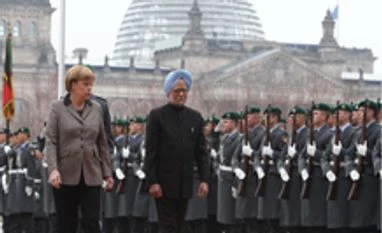
Shailesh Dobhal Berlin Prime Minister Manmohan Singh and German Chancellor Angela Merkel gave indications today that some more common ground may have been met on issues that has held back the much-awaited India-European Free Trade Agreement (FTA) talks, but the deal itself may still be sometime away.
Addressing a joint-press conference after conclusion of the intergovernmental consultations in Berlin, Merkel was measured on the FTA question, and said , “We’re almost there, (though) we’re not over all difficulties.” Prime Minister too acknowledged that there were “issues that has held back the FTA, but progress (was made) as well.”
Issues like the level of tariff protection for the Indian auto industry, data secure-status for India and taking FDI in insurance up to 49 % from the current 26% are still be resolved at the Brussels ministerial April 14-15.
“Issues around agriculture geographical indicators and non-agriculture market access are already resolved. On other issues we have to temper ambitions on both sides,” said Commerce and industry and textiles minister Anand Sharma who will be leading the minister-level talks with EU representatives next week. “There will also be a chapter on investment protection in this FTA,” added Sharma.
| The Agreements signed today, April 11, 2013 | |
| Name of the MoU | |
| Joint Declaration of Intent between Ministry of Human Resource Development and the Federal Foreign Office of Germany regarding promotion of German as a foreign language in India | ndian: Dr M. Mangapati Pallam Raju, Minister of Human Resource Development
|
German: Ms. Cornelia Pieper, Minister of State in the German Foreign Office
| Inter-Governmental MoUs between India and Germany on Cooperation in the field of higher education | Indian: Dr M. Mangapati Pallam Raju, Minister of Human Resource Development
German: Ms Johanna Wanka, Federal Minister of Education and Research |
| Joint Declaration of Intent on Indo-German cooperation in the area of Civil Security Research | Indian: Shri Jaipal Reddy, Minister for Science & Technology
German: Ms Johanna Wanka, Federal Minister of Education and Research |
| Joint Declaration between Department of Agriculture & Cooperation of India and the German Federal Ministry of Food, Agriculture & Consumer Protection, acting according to its mandate for the bilateral “Kooperations Program” of the German Federal Ministry of Food, Agriculture and Consumer Protection and the National Seeds Association of India and the German Association of Plant Breeders | Indian: Mrs. Sujatha Singh, Ambassador of India
|
German: Dr Gerd Muller, Parliamentary State Secretary, Federal Ministry of Food, Agriculture and Consumer Protection
| Joint Declaration of Intent by the Ministry of Consumer Affairs, Food and Public Distribution of India and Federal Ministry of Economics and Technology of the Federal Republic of Germany on the Establishment of an Indo-German Working Group on Quality Infrastructure for Cooperation in Standardisation, Conformity Assessment and Product Safety. | Indian: Shri Ranjan Mathai, Foreign Secretary
German: Anne Ruth Herkes, State Secretary at the Federal Ministry of Economics and Technology |
| Joint Declaration of Intent between Germany and India on Indo-German Development Cooperation regarding the Establishment of Green Energy Corridors | Indian: Dr Farooq Abdullah, Minister for New and Renewable Energy
|
German: Ms Gudrun Kopp, Parliamentary State Secretary
Ministers and officials from India and Germany today also signed one inter-governmental memorandum of understanding (MoU) and five joint declaration of intent in the presence of Prime Minister and the German Chancellor.
The sole MoU signed today was in the area of cooperation in the filed of higher education. Promoting German as a foreign language in India, cooperation in civil security research, food & agriculture, quality infrastructure and one on the development of ‘Green Energy Corridors’.
Prime Minister in his opening statement said, “Economic ties have been a defining feature of our relationship. I encouraged increased German participation in India’s rapid economic growth and our plans to modernise our manufacturing and infrastructure sectors. We agreed on the importance of an early conclusion of a balanced India-EU broad based Trade & Investment agreement.” Merkel in her statement emphasised on her country’s relationship with India and defined it as “very deep”, and spoke about opportunities that a billion-people plus country with all its concomitant need for infrastructure and investments provides Germany.

 "India-EU FTA talks 'almost there': Merkel")


 Connect with us on WhatsApp