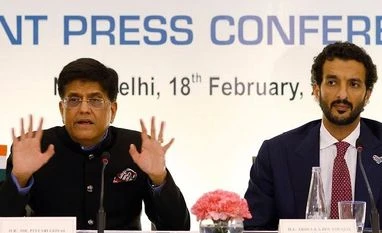
At a time when India is negotiating ambitious trade deals with the United Kingdom, Australia and the European Union (EU), it seeks to signal an image makeover by signing a free-trade agreement (FTA) with the UAE in a record 88 days.
India had abandoned the China-backed Asian trade bloc Regional Comprehensive Economic Partnership (RCEP) and EU Bilateral Trade and Investment Agreement (BTIA). This came after years of negotiations had raised doubts about India’s appetite for any trade deal.
Experts said while India is putting across a clear message that it is keen to do trade deals now, negotiating pacts with developed nations, nonetheless, will be complex. In the case of the trade deal with the UAE (signed last week), the complementarities are far more, making it easier to go ahead with such deals, they said.
“It (other FTAs) will be much more complicated. It was a different ball game with UAE. There weren’t many issues for the domestic industry because not much of what India imports from the UAE worries them. Other agreements have been very complicated and that explains why we have been taking a lot of time in negotiating them. However, we cannot really compare it (UAE trade deal) with that of other countries,” Biswajit Dhar, professor at Jawaharlal Nehru University said.
“The political intent seems strong in going ahead with the deals,” he added.
For instance, in case of an early harvest agreement or a limited trade with Australia, both nations had earlier set a December 25 or a deadline close to three months. However, the deal couldn’t be finalised as both countries were not able to iron out disagreements over market access.
Currently, both the countries are actively negotiating the deal and have set another ‘aggressive’ timeline of mid-March. Similarly, India had participated in the RCEP negotiations for nearly eight years, before deciding to walk away from the trade pact. India stated that it was not a balanced agreement and would have hurt India’s farmers, small businesses, and the dairy industry.
Formal negotiations between India and EU were stalled in 2013 over differences on a range of issues, after negotiations went on for six years.
“The change that we see from the time India moved out of RCEP is that the government is showing some strong political will to go ahead with signing trade deals. Now, the issue is how the government will manage the domestic constituencies that were opposed to all these deals two years back,” Dhar said.
Currently, India is actively negotiating an early harvest agreement or a limited trade deal with Australia and the UK.
A former trade ministry official said India-UAE Comprehensive Economic Partnership Agreement (CEPA) is a comprehensive trade deal. It concluded in record time, which hopefully will augur well for other pacts that India is negotiating.
While each FTA has its own dynamics, a lot depends on the complementarity with the nation or trade bloc, resulting in faster decision-making, the official said.
“UAE does not have much of a manufacturing base yet and around 36 per cent of its population of 95 lakh are Indians. It is also the second largest supplier of oil and gas to India,” the official said.

 "India eyes image makeover with UAE FTA deal in a record 88 days")












 Connect with us on WhatsApp