India-Japan defence ties are soaring but high-profile deals unlikely

The US-2i aircraft and the Soryu class project are indicative of a structural limitation in the India-Japan defence relationship
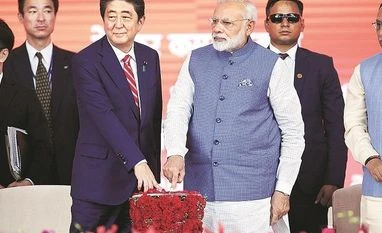
File photo: Prime Minister Narendra Modi and his Japanese counterpart Shinzo Abe
Prime Minister Narendra Modi and his Japanese counterpart Shinzo Abe press a button at the groundbreaking ceremony for a high-speed rail project in Ahmedabad. Photo: Reuters
Abhijit Singh
Last Updated : Sep 20 2017 | 12:11 PM IST
The India-Japan defence relationship is soaring, but high-profile deals like the US-2i Aircraft and Soryu class submarines are unlikely to come to fruition anytime soon, argues this writer in today's BS Special.
 
Japan Prime Minister Shinzo Abe's visit to New Delhi last week evoked much enthusiasm in India’s strategic community. From defence and dual-use technologies to counter-terrorism, connectivity, infrastructure creation in the Northeast, and a willingness to cooperate in Asia and Africa, India and Japan took their bilateral cooperation forward in a number of crucial areas, aligning New Delhi’s Act East Policy with Japan’s 'Free and Open Asia-Pacific Strategy' in the Indo-Pacific.


The developing synergy in the nautical commons was deemed an especially notable aspect of the warming India-Japan ties. While maritime engagement with Japan has risen steadily over the years — the Malabar joint exercise, its most visible manifestation — rarely has India gone beyond flagging freedom of navigation, overflight and unimpeded lawful commerce in maritime-Asia. 

The emphasis on a “rules-based order” in the joint statement this time was seen as a reflection of the two countries’ willingness to combine forces in the Asian littorals. Even though it did not mention the South China Sea, the bilateral communiqué underscored the importance of peaceful resolution of disputes, in accordance with the United Nations Convention on the Law of the Sea (UNCLOS).

Yet, progress on two critical fronts continues to be elusive. Despite the sense of anticipation in the run-up to Abe’s arrival in New Delhi last week, India and Japan failed to reach an agreement on the amphibious US-2i aircraft. They also seemed to have ducked a discussion on the transfer of critical undersea technologies and underwater platforms, particularly the sale of Japanese Soryu class submarines to India. Both areas merit a closer look.


The deal for the US-2i aircraft has been hanging fire since 2014 when Indian officials raised objections about the platforms high cost. At $133 million apiece, the aircraft was deemed expensive by Indian negotiators, leading to much bureaucratic resistance in clearing the proposal. The Indian Navy was keen to buy only two planes in the flyaway condition, insisting on license production for the rest — a demand Tokyo felt was both unviable and impractical. Notwithstanding the initial euphoria of a potential deal with India, therefore, negotiations grounded to a halt.

The proposal for the US-2i was revived in November 2016 when Prime Minister Narendra Modi visited Tokyo, partly because Japan agreed to lower the price of the aircraft by 10 per cent. Delhi was hopeful that the license production of the aircraft would impart momentum to the 'Make in India' initiative, as also lend credibility to the Indian Navy’s operational plans to counter growing Chinese presence in the Indian Ocean. 

Beyond geopolitical considerations, however, Delhi and Tokyo realised that the US-2i deal had come to so symbolise India-Japanese strategic cooperation and its failure would be deemed a setback for the bilateral relationship.

What wasn’t accounted for, however, was the aircraft’s limited capacity to play a strategic role in India’s maritime neighbourhood. Unlike the P-8i’s maritime reconnaissance plane and combat capabilities, the US-2i’s utility is restricted to a long-distance search and rescue role. While the aircraft does carry out limited surface-surveillance and sealift, it lacks the weapons and sensors required for strategic reconnaissance and combat missions. The aircraft’s benign mission profile, however, played no role in shaping the political narrative surrounding the platform, which assumed a momentum of its own.


On the eve of Abe’s visit, reports in the Indian media suggested New Delhi had decided to procure 12 aircraft in the flyaway condition, with a follow-on contract for 18 planes to be license produced in India. The news surprised India’s maritime watchers who were at pains to explain how the Navy's projected requirement for search and rescue operations in the Indian Ocean had suddenly doubled. Mercifully, the huge costs involved — a cumulative price of over $1.3 billion for 12 aircraft — seemed to have induced a rethink in the Indian camp, leading to a temporary freeze in negotiations.

With the Soryu class submarine too, the prospects for a deal look bleak. The Soryu is one of the world’s most sophisticated diesel-electric submarines, with a large size to weight ratio, capability for heavier weapon load, excellent stealth features and AIP technology. 

While Tokyo has always been secretive about its premier submarine’s design, its reasons for evading Delhi’s ‘feelers’ for a possible sale go beyond the desire for proprietary control. The Soryu is suited to favour longer patrols and operational flexibility — features that aren’t particularly relevant to the Indian Navy’s need, which is confined to near-seas littoral patrolling. 


More important for Tokyo, however, is the fact that the submarine does not offer any significant commercial advantage, especially with Indian industry’s limited capacity for high-technology absorption and a less than perfect track record of co-production.

New Delhi’s complex procurement procedures and fickle ship-construction practices add a further complication. A new-comer in defence trade, Japan is far from adept in forging partnerships with the domestic industry. Japanese submarine constructors fear that the integration of domestically produced Indian equipment on the Soryu might undermine the project. They also believe co-production with Indian industry could damage their reputation for timely delivery, especially if critical fitments outsourced to Indian firms are delayed, or if additional changes are forced on the original platform design.

The US-2i aircraft and the Soryu class project are indicative of a structural limitation in the India-Japan defence relationship. While the two proposals symbolise warming bilateral ties, they cater neither to New Delhi’s operational needs nor Tokyo’s commercial expectations. Maritime pundits in both countries must not view these as a barometer of the developing strategic partnership.

Abhijit Singh is Head of the Maritime Policy Program at the Observer Research Foundation and a former naval officer. He tweets at @abhijit227

One subscription. Two world-class reads.

Already subscribed? Log in

Subscribe to read the full story →
*Subscribe to Business Standard digital and get complimentary access to The New York Times

Smart Quarterly

₹900

3 Months

₹300/Month

SAVE 25%

Smart Essential

₹2,700

1 Year

₹225/Month

SAVE 46%
*Complimentary New York Times access for the 2nd year will be given after 12 months

Super Saver

₹3,900

2 Years

₹162/Month

Subscribe

Renews automatically, cancel anytime

Here’s what’s included in our digital subscription plans

Exclusive premium stories online

  • Over 30 premium stories daily, handpicked by our editors

Complimentary Access to The New York Times

  • News, Games, Cooking, Audio, Wirecutter & The Athletic

Business Standard Epaper

  • Digital replica of our daily newspaper — with options to read, save, and share

Curated Newsletters

  • Insights on markets, finance, politics, tech, and more delivered to your inbox

Market Analysis & Investment Insights

  • In-depth market analysis & insights with access to The Smart Investor

Archives

  • Repository of articles and publications dating back to 1997

Ad-free Reading

  • Uninterrupted reading experience with no advertisements

Seamless Access Across All Devices

  • Access Business Standard across devices — mobile, tablet, or PC, via web or app

Next Story


