
India struggles to contain vegoil prices as Indonesia restricts exports
Mindful of an electorate that is highly sensitive to food price inflation, India's government tried to rein in domestic prices by reducing import taxes
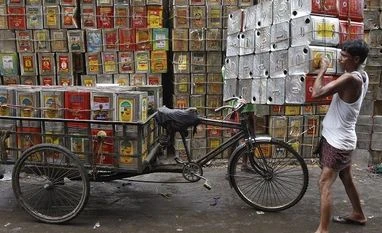 "India struggles to contain vegoil prices as Indonesia restricts exports")
Explore Business Standard
Mindful of an electorate that is highly sensitive to food price inflation, India's government tried to rein in domestic prices by reducing import taxes
India's attempts to lower edible oil prices ahead of important state elections have been ruined by a spike in global palm oil prices to record highs after Indonesia, the world's biggest supplier, moved restrict exports.
Mindful of an electorate that is highly sensitive to food price inflation, India's government tried to rein in domestic prices by reducing import taxes, imposing stockpile limits and suspending futures trading in edible oils and oilseeds.
Those efforts initially yielded some success.
But as India imports two-thirds of its edible oils, the benefits of the duty cut and other measures have been virtually erased by the surge in global prices after Indonesia ordered producers to sell 20% of their sales to the domestic market to cool local cooking oil prices.
"Indonesia's move has complicated India's efforts to bring down prices," said B.V. Mehta, executive director of Mumbai-based Solvent Extractors' Association of India (SEA).
Spot prices of palm oil, the most consumed edible oil in the country, have risen more than 12% so far in 2022 to 1,228 rupees per 10 kg after hitting a record high of 1,280.75 rupees in May 2021.
The price of rival oils such as soyoil and sunflower oil jumped as buyers scrambled to replace lost palm oil volumes, increasing import bills for the world's biggest edible oil importer and making it difficult for New Delhi to rein in costs for consumers.
Previously, palm oil was by far the most imported oil in India, but "at the current price level there is no advantage to buy palm oil," an Indian refiner, who declined to be named, said.
Crude palm oil (CPO) is being offered at around $1,450 a tonne, including cost, insurance and freight (CIF), in India for March shipments, compared with $1,490 for crude soybean oil and $1,455 for crude sunflower oil, traders said.
A year ago, palm oil was trading at a discount of around $100 and $250 per tonne to soyoil and sunflower oil respectively, both regarded as better quality than palm oil.
India's retail food price inflation rose to 4.05% in December, and analysts expect it to stay on an upward trend in coming months.
How this impacts the election in Uttar Pradesh, India's most populous state, and a prize currently controlled by Prime Minister Narendra Modi's Bharatiya Janata Party, will be closely watched. Voting starts there on Feb. 10, and will be followed by elections in Goa, Punjab, Manipur and Uttarakhand over the next few weeks.
But there is little more the government can do to dampen edible oil prices.
"It can't reduce import taxes further. The only option the government has is to subsidise edible oils," said a Mumbai-based dealer with a global trading firm.
"It can sell edible oils at lower prices to poor people via the public distribution system. But this requires lots of funds and government has already been struggling to contain its fiscal deficit."
Officials had even lobbied the members of edible oil trade bodies to keep a lid on prices, but were met with the harsh market realities.
"We cannot sell imported oil at a lower price than our purchase price," said a Mumbai-based edible oil refiner.
(Reporting by Rajendra Jadhav; Editing by Gavin Maguire and Simon Cameron-Moore)
(Only the headline and picture of this report may have been reworked by the Business Standard staff; the rest of the content is auto-generated from a syndicated feed.)
First Published: Feb 08 2022 | 8:08 PM IST


