Infrastructure attracts investment; its very creation would also provide a demand push to the economy
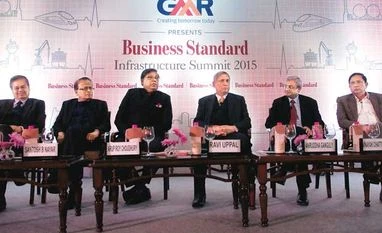
(From left) Rathin Basu, country president, Alstom India and South Asia; S B Nayar, chairman and managing director, India Infrastructure Finance Company; Arup Roy Chowdhury, chairman and managing director, NTPC; Ravi Uppal, chief executive officer an
The infrastructure sector could provide a double push to the government's 'Make in India' programme, both cause and effect. While good infrastructure attracts investment, its creation itself can give much-needed demand push to the economy.
Not surprisingly, at the Business Standard Infrastructure Summit, 2015, Railways Minister Suresh Prabhu emphasised the need to embark on an infrastructure-led growth path to ensure a favourable investment cycle.
The summit began on January 15 with Prabhu's address, followed by a panel discussion, where the participants were Rathin Basu, country president, Alstom India and South Asia; S B Nayar, chairman and managing director, India Infrastructure Finance Company (IIFC); Arup Roy Chowdhury, chairman and managing director (CMD), NTPC; Ravi Uppal, chief executive officer and managing director, Jindal Steel & Power; Aniruddha Ganguly, president for strategy and development, GMR Energy; and Vinayak Chatterjee, chairman, Feedback Infrastructure.
After the panel discussion, Petroleum Minister Dharmendra Pradhan provided a perspective on challenges facing policy makers. A lively discussion followed, where analysts and infrastructure professionals got an opportunity to interact with the minister. There was consensus that infrastructure development would depend heavily on how public sector undertakings (PSUs) invest in and leverage their projects for a smooth fund flow. NTPC's Roy Chowdhury was sceptical - he felt PSUs have to balance investment with social responsibility. Feedback Infrastructure Chairman Chatterjee raised doubts about how the money from stake sale in PSUs - which goes into the Consolidated Fund of India - was being utilised. He wondered why it was not being used for infrastructure investment.
Drawing a parallel between India and Japan, Railways Minister Prabhu said Japanese corporates had cash flow as high as 40 per cent of their gross domestic product but they were not investing. "The Japanese economy is contracting but the private sector is not investing. In India, PSUs have huge cash flow but are depositing it in banks for five or six per cent, creating problems for the banks. Why can't we use PSU as engines of growth?"
Though land and financing were identified as key challenges for infrastructure growth, Prabhu emphasised the need for not only new ideas and institutions but financing instruments. One such bold direction would be to open up the Employees' Provident Fund Organisation (EPFO). The suggestion found support from Nayar, who said two to three per cent of the EPFO's incremental corpus could be used to meet the core sector need. GMR Energy senior executive Ganguly, however, raised the issue of foreign investors' lack of interest in India. "They (foreign players) are sceptical due to the retrospective tax regime."
Providing the lender perspective, Nayar said, "We need to develop more infrastructure financing institutions like IIFC. Nothing prevents us from creating non-banking financial companies for infrastructure outside of Basel-III." He added problems such as delays, cost over-runs and complicated land acquisitions, beside the macro economic environment, affect a project. "Reserve Bank of India can't changes rules for a sector going through a rough patch."
Petroleum Minister Pradhan said policy reform was a major challenge for the government. "In the next 10-15 years, India's annual economic growth will move into double digits."

 "Infrastructure sector's double-push potential")


 Connect with us on WhatsApp