ISA targets $1 trn in solar funds by 2030; S Asia in phase-1 of world grid

Talks will also revolve round the $1 trillion Solar Investment Roadmap for 2030, and approval of a blended financial risk mitigation facility
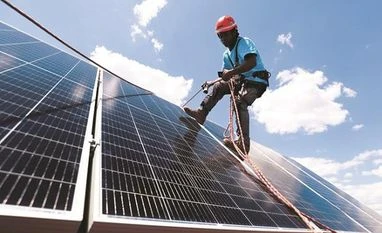
green energy
The ISA during the first day of meetings in its fourth general assembly discussed the OSOWOG plan and the need for it to be part of the India’s climate action plan
Shreya Jai New Delhi
3 min read Last Updated : Oct 18 2021 | 10:39 PM IST

Don't want to miss the best from Business Standard?

To kickstart the ambitious One Sun, One World, One Grid (OSOWOG) project floated by the International Solar Alliance (ISA), the South Asian network and existing power transfer between India, Nepal, Bhutan and Bangladesh would be boosted in the first phase of the action plan.

Prime Minister Narendra Modi in his Independence Day address last year, reiterated the mega plan of having OSOWOG or a transnational electricity grid supplying solar power across the globe. The idea was first announced by the PM in 2018 during the first assembly of another international entity, the ISA.

A government statement said, the Fourth Assembly of the ISA, which is being hosted in India this week, will deliberate on the key initiatives around the operationalisation of the OSOWOG initiative, the $1 trillion Solar Investment Roadmap for 2030, and approval of a blended financial risk mitigation facility.

The ISA during the first day of meetings in its fourth general assembly discussed the OSOWOG plan and the need for it to be part of the India’s climate action plan. Ajay Mathur, director general, ISA said the this is an economically viable idea and ISA will soon release the report it commissioned to study the viability of the project.

He said the tender ISA floated with the World Bank was won by a consortium led by French utility EDF along with French consultancy firm AETS and TERI from India.

The World Bank, which has signed a tripartite agreement with ISA and the ministry of new and renewable energy (MNRE) for implementing OSOWOG, said during the assembly that the project has two key components – South Asia Power Pool and India GCC Electricity Interconnection.

Amit Jain, senior energy specialist, World Bank, said the plan does not only restrict to a global grid but includes energy storage, decentralised renewable energy and all forms of renewable energy projects. “It will be an interconnection of regional interconnections. The OSOWOG is also collaborating with the UK which is planning a Green Grids Initiative (GGI). We have also identified projects in Africa and the UK with their own super grids which can be part of global connection,” Jain said during his presentation on OSOWOG.

He said as the first step, the electricity transfer between India and the neighbouring countries can be boosted. “There is already 3 Gw of transfer capacity already installed between Bhutan, Bangladesh, Myanmar and Nepal with India. It can be increased to 7 Gw by 2023, and if plans are fulfilled,  this capacity can be doubled to 14 Gw by 2025,” Jain said.

He added there are informal discussions taking place to grow inter-regional transfer capacity to 63 Gw between these nations.

In the ongoing fourth general assembly of the ISA, member countries will also discuss the strategic plan of the ISA for the next five years encompassing a Country Partnership Framework, Strategy for Private Sector Engagement, and initiatives such as Viability Gap Financing scheme to facilitate affordable finance for solar energy projects across ISA’s membership.

The assembly comes just weeks ahead of the UN Climate Change Conference (COP26) which is slated to take place at the end of this month in Glasgow, UK.

Officially announced during the COP21 in Paris in 2015, the ISA is a partnership of solar resource-rich countries. Currently, 121 countries have agreed to be members of ISA. Most of these are countries with a large participation from Africa, South-east Asia, and Europe. Pakistan and China are not members of the ISA. It is headquartered in Gurugram.

One subscription. Two world-class reads.

Already subscribed? Log in

Subscribe to read the full story →
*Subscribe to Business Standard digital and get complimentary access to The New York Times

Smart Quarterly

₹900

3 Months

₹300/Month

SAVE 25%

Smart Essential

₹2,700

1 Year

₹225/Month

SAVE 46%
*Complimentary New York Times access for the 2nd year will be given after 12 months

Super Saver

₹3,900

2 Years

₹162/Month

Subscribe

Renews automatically, cancel anytime

Here’s what’s included in our digital subscription plans

Exclusive premium stories online

  • Over 30 premium stories daily, handpicked by our editors

Complimentary Access to The New York Times

  • News, Games, Cooking, Audio, Wirecutter & The Athletic

Business Standard Epaper

  • Digital replica of our daily newspaper — with options to read, save, and share

Curated Newsletters

  • Insights on markets, finance, politics, tech, and more delivered to your inbox

Market Analysis & Investment Insights

  • In-depth market analysis & insights with access to The Smart Investor

Archives

  • Repository of articles and publications dating back to 1997

Ad-free Reading

  • Uninterrupted reading experience with no advertisements

Seamless Access Across All Devices

  • Access Business Standard across devices — mobile, tablet, or PC, via web or app

Topics :Climate ChangeInternational Solar Alliancesolar energyNarendra ModiWorld Bank

Next Story



