Even as southwest monsoon makes its way to north India, sowing of most kharif crops has picked up pace.
But it is still less than 2014, especially because of a drop in the acreage of coarse cereals, particularly maize.
However, experts warned against making any firm projection on kharif production based on the current pace of sowing as the total area covered so far is just 8.7 per cent of the total area that is usually covered during the kharif season, which is 105.28 million hectares.
The total acreage under all kharif crops was around 7.35 per cent less than the same period last year at 9.16 million hectares. Till last week, this difference was over 8.5 per cent.
In western parts of the country, though, the rains continued their strong run and Mumbai was battered by heavy showers since the last 24 hours, throwing life out of gear.
Coarse cereals have been planted in around 0.71 million hectares till June 19, down from 1.24 million during the same period last year.
Farmers tend to hold on to their coarse cereals crop at times when rainfall looks uncertain as it matures fast and can survive on low moisture as well.
The biggest thrust to sowing will come in the months of July and August, when the monsoon settles over the critical pulses, oilseeds and cereal growing regions of central, north and western India. It is here that the forecast available till now does not look promising enough.
The Pune-based Indian Institute of Tropical Meteorology (IITM) in its last weather update said that a low pressure system will develop over the southern Bay of Bengal, which could give good rainfall over central India between June 21-25 and thereafter it might move towards the northern parts of the country between June 25-30. The southwest monsoon might cover the entire country by June and the rains would be normal to above this month.
But, thereafter IITM said that rainfall might go down in the first week of July. India Metrological Department (IMD) too said in its update that all models are suggesting an overall decrease in monsoon rainfall over most parts of the country in the beginning of July.
If the rains loose their intensity in July after the covering the entire country by June end then that could have an impact on the final harvest as that is the time when real thrust to sowing comes.
But, how big that impact would be remains to be seen.
India Ratings in a report said today that the correlation between the kharif food grain output and monsoon rains (June-September) declined to 0.3 over FY05-FY14 as compared with 0.6 for FY97-FY04, which shows the increased resilience of Indian agriculture to absorb deficiency in monsoon rainfall.
It further added that if 2015 monsoon is as per Skymet’s forecast of 102 per cent of Long Period Average (LPA) then agriculture GDP will grow by 2.1 in 2015-16, but if it matches the IMD’s forecast of below normal rains then farm GDP could grow at 1.0-1.5 per cent in 2015-16.
Further, if north India gets poor rains and overall showers are also weak, then GDP would grow at 0.0-0.5 per cent in 2015-16.
So far the rains since June 1 have been 10 per cent more than normal, largely due to good rains over central, south and east India.
Till June 19, however, paddy has been sown in around 0.83 million hectares, up from 0.82 million hectares, pulses have been sown in 0.45 million hectares, which is just 4.16 per cent of the normal area, up from 0.43 per cent during the same period last year.
Oilseeds have been sown in around 0.27 million hectares, marginally more than the 0.22 million hectares that has been sown last year. In total, oilseeds are planted in around 18.23 million hectares of land during the kharif season.

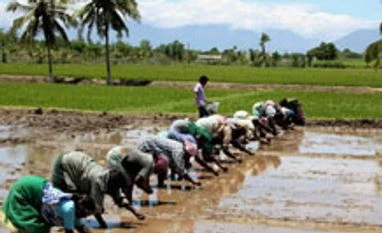 "Kharif sowing shows signs of revival, but still a long way to go")


