Merchandise exports unlikely to recover soon
Global crash in commodity prices, slowdown in Chinese economy to plague outbound shipments
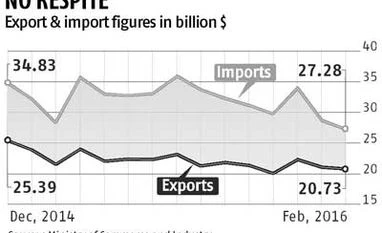
Subhayan Chakraborty New Delhi With the trade figures for March expected to remain weak, India’s merchandise exports are likely to improve only towards the end of 2016, according to experts. Falling for the 15th straight month till February, India’s exports would be difficult to revive in the next couple of months, say experts.
Adverse global market conditions such as the crash in commodity prices and slowdown in the Chinese economy have caused exports to nose-dive for a longer stretch than even during the 2008-09 global financial meltdown, when the decline was for nine months on the trot.
According to S C Ralhan, president of the Federation of Indian Export Organisations, these conditions are likely to remain volatile throughout the greater part of 2016 and outbound shipments would improve only from the last quarter of the year.
The government also expects exports to strengthen only next year on the back of an uptick in petroleum and commodity prices globally.
“There are signs the commodities slump might recede with rising prices in the next six months, along with the Chinese economy making a comeback,” said Mukesh Bhatnagar, professor, Centre for WTO Studies at Indian Institute of Foreign Trade.
The World Trade Organization (WTO) had also last week cut its forecast for global growth in merchandise trade in 2016 to 2.8 per cent, from the previous forecast of 3.9 per cent. It blamed worsening financial market volatility and rising exposure of countries with large foreign debts for the sluggish growth.
However, WTO forecasts a 3.6 per cent rise for 2017, commensurate with better conditions for trade growth from the latter part of 2016. Due to the sustained fall in merchandise exports, the government has had to revise its cumulative exports target for 2015-16, from the initial $300 billion to $260-270 billion.
India exported goods worth $238 billion during the first 11 months of FY16, which was 16.7 per cent lower than $286 billion in the corresponding period of the previous year. As much as $22-32 billion worth of goods need to be exported in March to meet even the truncated target.
Even if this target is met, it would be $50 billion lower than the previous year’s realisation at the lower end and $40 billion at upper end. This would also mark contraction for the second year in a row.
To boost exports, the government should take suitable action on the policy front, according to experts who have repeatedly cautioned the government against stressing solely on new markets to generate exports.

 "Merchandise exports unlikely to recover soon")


 Connect with us on WhatsApp