Monetary policy committee is in economy's interest: Rajan
Says committee will aggregate multiple views better than an individual, offer more continuity, and be under less pressure
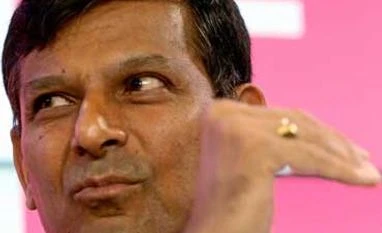
BS Reporter New Delhi Reserve Bank of India (RBI) Governor Raghuram Rajan said on Saturday that shifting the monetary policy decision to the hands of a committee, rather than depending on the RBI governor alone, is in the interest of the economy and this should be seen as an achievement of the government.
“While the RBI governor will no longer be able to set monetary policy unilaterally, I believe shifting the decision to a committee is in the economy’s interest. Not only will a committee aggregate multiple views better than an individual can, it will offer more continuity and will be less subject to undue pressure,” Rajan said at the Ramnath Goenka Memorial lecture in New Delhi.
“I believe the monetary reforms of this government will stand out as one of its signal achievements,” he said.
Union Finance Minister Arun Jaitley had said in his Budget speech that the proposed six-member monetary policy committee will be made a law.
The committee will be guided by the monetary policy framework and will be responsible for keeping inflation under four per cent in the medium term, with a deviation of plus/minus two per cent. If the monetary policy is not able to meet this target for three consecutive readings, the panel, which includes the RBI governor, will be answerable to the government.
Rajan lauded the government for emphasising the importance of fiscal prudence, even as it adhered to past commitments, and allocating resources towards capital spending and focusing on structural reforms, especially in agriculture. The fiscal consolidation, combined with lower commodity prices, has led to a lower current account deficit, he said.
On the question of what India should do when the international investor is “manic depressive in his behaviour” and all countries are striving for extra growth, Rajan said it is important that the domestic environment is kept robust.
“Importantly, when global growth is uncertain, we should make sure that our domestic environment promotes strong, sustainable and stable growth. This requires a firm platform of macroeconomic stability.”
The last leg of the stabilisation agenda is to clean up the stressed assets in the banking sector so that banks have the room to lend again.
“The problem in the past was that banks simply did not have enough powers to force promoters to or to put stressed assets back on track. Unlike more developed countries, we do not have a functioning bankruptcy system, though a Bill is currently before Parliament,” Rajan said.
“There are a variety of reasons why loans have gone bad, apart from malfeasance. Let’s be very careful. You don’t want to paint everyone with the same brush.
If you want to investigate every case where loans have gone bad, you will kill lending and entrepreneurship,” Rajan added.

 "Monetary policy committee is in economy's interest: Rajan")

