More women Union ministers in 2015: Report
Participation rises to 17%, says MoSPI report
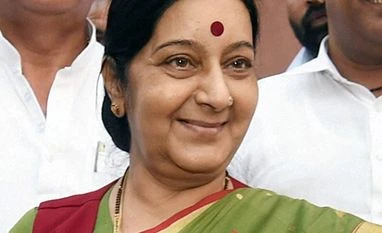
BS Reporter New Delhi Of the 45 ministers in the central council of ministers in 2015, eight are women. This amounted to roughly 17 per cent of the strength of the central council of ministers, said a report by the Ministry of Statistics and Programme Implementation (MoSPI).
In 2004, women comprised only 10 per cent of the council of ministers.
The difference in absolute terms was marginal. But in percentage terms it reflected a sharp increase.
Of the eight ministers in 2015, six are Cabinet ministers and two are ministers of state. In all, 62 women were elected in the 2014 General Elections — roughly 11 per cent of the strength of the Lok Sabha.
Of these 62 members of Parliament (MPs), 34 per cent were social and political workers and 18 per cent were farmers, according to the report, Women and Men in India. As many as 44 per cent of these MPs were postgraduates and 29 per cent were graduates. Only 29 per cent of the male members were postgraduates, while 44 per cent were graduates.
Among state Assemblies, Bihar, Haryana and Rajasthan have the highest women participation. Mizoram, Nagaland and Puduchery have no women representation in the Assembly.
In the judiciary, though, women’s participation continued to be limited. There was only one woman judge out of 28 in the Supreme Court. At the high courts, there were only 65 women judges out of 546 judges. In percentage terms, the highest women participation was seen in Sikkim (33 per cent), followed by Delhi (23 per cent), Punjab and Haryana (17 per cent) and Mumbai (16 per cent). Surprisingly, there were no women judges in the high courts in Chhattisgarh, Himachal Pradesh, Jammu and Kashmir, Jharkhand, Manipur, Meghalaya, Tripura and Uttarakhand.
In the Indian Administrative Service, only 14 per cent were women in 2012. In comparison, the Indian Economic Service saw 30 per cent in 2014. The Indian Foreign Service, at 19 per cent, had higher women participation than the Indian Administrative Service.

 "More women Union ministers in 2015: Report")


 Connect with us on WhatsApp