Move away from fixed tax targets: Shome
'Link these to changing economic scenario'
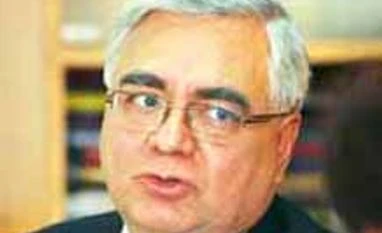
Vrishti Beniwal New Delhi A tax reforms panel, headed by finance minister's advisor Parthasarathi Shome, is considering moving away from setting fixed tax-collection targets and linking these with the changing economic scenario during the year.
The idea, if implemented, might help ease pressure on the tax administration to meet targets set at the start of the year.
The Tax Administrative Reforms Commission (TARC), which was likely to file its first report to the government by the end of May, had received representations that a static target exerted unnecessary pressure on both field officers and honest taxpayers who were asked to pay more if there was a shortfall, an official who did not wish to be named said.
"All countries that I know have moved away from the static revenue target principle. The target moves depending on the economy. The difference between the moving target and what you collect is the gap. Minimise the gap over a fortnight, over a month, over a quarter. We must move in that direction," Shome told Business Standard.
He said the administration faced tremendous pressure to collect revenue irrespective of the condition of the economy.
"That, in turn, is one reason of extreme dissatisfaction among taxpayers. That also makes it infeasible to go after real evaders, since it turns good taxpayers into bad," Shome added.
The TARC is also reviewing judicial powers of assessing officers by looking at how decisions are made in terms of prevention, management, and resolution of tax disputes. The assessing officer is a quasi-judicial authority for the tax department who can disallow expenditure shown by an assessee, make adjustments to income, call for information, conduct searches, reopen assessments and have accounts audited.
"The issue is authority rests at a relatively junior level. Is that the right place? We can consider where the first adjudicating level lies. Does it also imply the upper levels should not have any authority? That is what we are considering, since many of the disputes are at the assessing-officer level," Shome said.
Asked whether there was a proposal to merge the Central Board of Direct Tax and the Central Board of Excise and Customs, he said the TARC was examining whether some operations, such as information technology, could be clubbed.
"What we are saying is, try and find out where the two departments have common interests and then see whether you can generate better product delivery through combining them," Shome added.
He said despite Large Taxpayer Units (LTUs) being established in 2006, "little synergy has been reaped so far between the departments, while 50 countries have proceeded with that very approach. Should we not benchmark ourselves as well?"
The TARC, set up in March this year to review tax policies and laws against global best practices and recommend reforms, must submit its report in 18 months.

 "Move away from fixed tax targets: Shome")


 Connect with us on WhatsApp