Nature's fury, man's folly: Water crisis is a dilution of efforts in TN

After thernocol, govt would now look at covering surface of the reservoir with black rubber balls
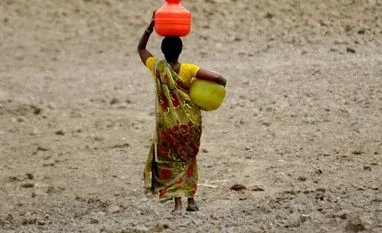
drought
Gireesh BabuT E Narasimhan Chennai
Last Updated : May 02 2017 | 12:17 AM IST
Sellur Raju, minister for co-operatives in Tamil Nadu, had floated an idea to stop the evaporation of water from reservoirs: Deploying thermocol sheets on the surface of the Vaigai dam. But the thermocol sheets used to check evaporation could not withstand wind pressure.

The government would now look at covering the surface of the reservoir with black rubber balls, which was done in some countries, the minister says. This has been ridiculed by many, and some say such plans lack seriousness.

The government has allocated Rs 10 lakh for the project. 

Natural handicap

The state in 2016 received 550 mm of rain as against the annual average of 945 mm, which amounted to a 41% deficit. There was 168 mm of rain during the north-east monsoon, October-December, as against the average of 440 mm, which amounted to a 62% deficit. The north-east monsoon in 2016 is said to be the worst after 1876, when 163 mm of rain was recorded.

Tamil Nadu gets around 48% of its rain during the north-east monsoon (October-December), around 32% during the south-west monsoon (June-September), and the rest is distributed over the remaining part of the year.

While the Cauvery basin on the Karnataka side gets rain during the south-west monsoon, the basin on the Tamil Nadu side benefits from the north-east rain. Karnataka has the advantage of being an upper riparian state with four dams, while Tamil Nadu is a lower riparian state that depends on the flow from Karnataka. For decades the two states have been fighting over the distribution of the Cauvery waters.

Of all the southern states, Tamil Nadu faces the worst water scarcity since the state does not have any perennial water source. The origin of the Krishna and Godavari is in Andhra Pradesh, the Cauvery starts from Karnataka, and Kerala has a number of small rivers with a high volume of water.

Human errors

Farmers and activists agree it is as much a man-made disaster as a natural one. Neither the government nor the people are bothered about conserving water and exploit water resources in the name of urbanisation and industrialisation, says activist Nityanand Jayaraman. He says there were heavy floods in Tamil Nadu in 2015, but no water was saved. Chennai received more than 1,700 mm of rain in three weeks. Typically, December receives 191 mm.

There are 3,600 tanks in the state and all of them are bone dry. The tanks went dry within a month of the 2015 floods, he says.

The state government has not taken any steps to build bunds to store river water, says N G Murugaiyan, a functionary of the Tamil Nadu Farmers’ Association (TNFA), Tiruvarur district.

Government officials, however, say that the state’s terrain is such that it is not easy to store water. The rivers originate in the plains and hence it will not be possible to create reservoirs.

The exploitation of groundwater, which has lowered the water-table significantly, may trigger a crisis in many parts of the state in the hot months. In some areas deep drilling in search of water results in salty seawater seeping into aquifers. 

Industrial impact

The hit that the rural economy has taken due to the drought has impacted various industries. While factories in and around Chennai have said that they are getting water as promised by the government, factories are feeling the heat in southern parts of the state.

Tamil Nadu Newsprint has said that it stopped production at its Karur unit in March. According to Seshasayee Paper and Boards, revenue officials of Tirunelveli district suspended drawing water from the river Thamirabharani for industrial use with effect from May 1.

Fast-moving consumer goods players said that sales had been down 20-30% over the past three-four months. Similarly, two-wheeler dealers say sales are down nearly 50%. A dealer representing one of the top three two-wheeler brands at Tiruvarur says he used to sell 20 vehicles a month.

The Indian Bank chief executive officer said credit growth slowed due to the drought. Around 400,000 acres has been converted into residential and other real estate projects and the conversion of fields into real estate is increasing over the past few years and is expected to grow.

“This year alone, more than 25,000 acres might have been sold to real estate,” said Sami Natarajan, Thanjavur district secretary, TNFA.

Relief measures

The state government announced in January that all the districts in the state were drought-hit. This came after the Kerala government made a similar declaration. 

The complaint of the public and the opposition is that the ruling party, the All India Anna Dravida Munnetra Kazhagam, is not worried about the water crisis. But ministers deny this, and blame nature and neighbouring states for not being supportive.

The state has asked the National Disaster Response Fund authorities for Rs 40,000 crore, but the Centre has sanctioned around Rs 1,804 crore as drought relief fund, which has angered the public, especially farmers. The state’s debt waiver scheme would result in around Rs 7,000 crore of debt for the state government. 

The government was spending Rs 976.76 crore on tackling this water shortage, said the minister for municipal administration, S P Velumani. In addition, in rural areas drinking-water projects of Rs 703 crore are being taken up; Rs 98.57 crore is being spent on refurbishing 1,898 water-resources structures; 1,337 new borewells and drought relief work are being taken up at Rs 65.35 crore; 15 million litres of water is being distributed daily through water tankers in cities and towns; and 1,565 million litres of water is being supplied through 553 integrated water supply projects, benefitting 42.1 million people.

Anticipating the possibility of reservoirs drying up in May, projects worth about Rs 100 crore are being taken up.

Meanwhile, the state agriculture department has advised farmers to cultivate less water-intensive crops such as millet and pulses.

Around 500,000 acres will be covered under the Mission on Sustainable Dry Land Agriculture programme, with the main focus on promoting millet, pulses and oilseeds in the current financial year.

The Mission will be implemented in 25 districts for four years with an outlay of Rs 803 crore.

Stressing that Tamil Nadu has the highest millet productivity in the country, an official said, “The land under millet cultivation has increased between 2010-11 and 2014-15, from 500,000 hectares to 900,000 hectares.”

The official also said farmers had not adopted drip irrigation properly.


One subscription. Two world-class reads.

Already subscribed? Log in

Subscribe to read the full story →
*Subscribe to Business Standard digital and get complimentary access to The New York Times

Smart Quarterly

₹900

3 Months

₹300/Month

SAVE 25%

Smart Essential

₹2,700

1 Year

₹225/Month

SAVE 46%
*Complimentary New York Times access for the 2nd year will be given after 12 months

Super Saver

₹3,900

2 Years

₹162/Month

Subscribe

Renews automatically, cancel anytime

Here’s what’s included in our digital subscription plans

Exclusive premium stories online

  • Over 30 premium stories daily, handpicked by our editors

Complimentary Access to The New York Times

  • News, Games, Cooking, Audio, Wirecutter & The Athletic

Business Standard Epaper

  • Digital replica of our daily newspaper — with options to read, save, and share

Curated Newsletters

  • Insights on markets, finance, politics, tech, and more delivered to your inbox

Market Analysis & Investment Insights

  • In-depth market analysis & insights with access to The Smart Investor

Archives

  • Repository of articles and publications dating back to 1997

Ad-free Reading

  • Uninterrupted reading experience with no advertisements

Seamless Access Across All Devices

  • Access Business Standard across devices — mobile, tablet, or PC, via web or app

Next Story



