As men fear vasectomy, onus of family planning falls on Indian women

India's latest health data show that nearly 38% of women have undergone sterilisation but only 0.3% of men have had vasectomies
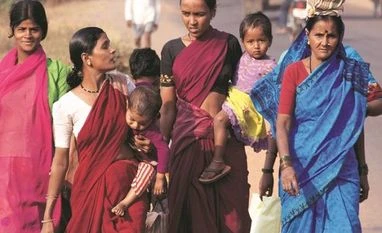
women
Ranvijay Singh | IndiaSpend
6 min read Last Updated : Apr 30 2022 | 5:39 PM IST
On a Thursday, at around 1 p.m., many women had gathered at a community health centre (CHC) in Uttar Pradesh's Mahoba district. They were all waiting for their turn to undergo a procedure for permanent contraception, sterilisation or the sealing of the fallopian tubes. Thursdays, across public health facilities in Uttar Pradesh, are reserved for sterilisation surgeries and vasectomies for men, which blocks the sperm--both, methods of contraception.

There were men who had accompanied women, but there were no men waiting for their own surgeries when IndiaSpend visited Jaitpur CHC in Mahoba.

Why did Rajesh Kumar (38), a resident of Barkheda village, not opt for a vasectomy, and why was his wife, Gudiya, undergoing sterilisation? A few women sitting behind him giggled on hearing the question. After a long pause, Rajesh said: "I feel scared."

Between 2019 and 2021, nearly 38% of women surveyed nationwide for the fifth National Family Health Survey had undergone sterilisation, compared to just 0.3% of men who had undergone a vasectomy. In comparison, 17% of women surveyed in Uttar Pradesh had undergone sterilisation compared to 0.1% of men.

Why men fear vasectomies

"We perform 30 family planning procedures in a day, and all the patients are women," said P.K. Singh, the medical superintendent at the Jaitpur CHC. "A lot of money is spent on creating family planning awareness, but men still hesitate. In the year 2020, while 545 women came to us, only three men opted for a vasectomy."

In 2020, the number of men opting for family planning procedures in Jaitpur, at three, was the most of all CHCs in the district, said Singh.

When Accredited Social Health Activists, or ASHAs, visit homes to encourage men and women to adopt contraception, they find that the men are reluctant. "We encourage the men too, but they very sternly tell us that it's the women who will have to undergo the procedure," said Ram Sati, an ASHA worker from Lamora village in Mahoba. "Even the women say they will opt for it as they don't want to bother the men."

One of the reasons is the myths behind the procedure. "There is a general perception that men become weak after family planning procedures. We tell them that it's a simple procedure and they would not even have to get stitches, they still hesitate," said Omvati, an ASHA worker, who lives in Akona village. "Even the women feel their husbands will become weak if they would opt for it."

When we spoke to men who were accompanying their wives for family planning procedures, they echoed Omvati's words. "I don't know a single man who has opted for this, which is why I feel scared. As mostly it's the women who are undergoing this procedure, I asked my wife to go for it," said 42-year-old Manoj. "I have heard that men become weak after this operation." When asked where he got that information, he said: "Everyone says so."

To encourage men to opt for the family planning procedure, the government organises a nasbandi pakhwada (a vasectomy awareness programme) every year. The men are counselled at these drives, yet there is no change in the numbers.

Poor facilities for women

On a chilly winter night in December 2021, several women lay on thin mattresses on the floor in Mehrauni CHC in Uttar Pradesh's Lalitpur district. Some family members were carrying women on their backs after the operation, as there were not enough stretchers for all those who had come.

"There is not enough space in the CHC. I don't have enough beds, so we give the patients mattresses," said M.P. Singh, the CHC's medical superintendent. "We advise them to go home after the procedure and call them from time-to-time for check-ups."

Women do not get the kind of care they should be getting after undergoing family planning procedures. At the Birgha CHC in Lalitpur, women were lying down on the floor on mattresses after their operation. The CHC's medical superintendent, Chatrapal Singh, said: "We perform 30 procedures in a day. We have 10-12 beds as well as mattresses."

When asked if women have to stay at CHCs for a few days after the procedure, he said: "There is a norm that they have to be kept under observation for at least one day/night, but we don't have enough beds. Besides, they themselves are not very comfortable about staying at the CHC and choose to go home."

Low awareness about family planning among men

India's family planning campaigns, run by both its public health systems and civil society programmes, are focussed almost entirely on women, found a study by the International Center for Research on Women (ICRW). Further, men are the ones who make decisions on how many children a couple should have and when, as we reported in September 2020.

Up to 54% of men said that their wives could not use contraception without their permission and one-fifth believed that it is a woman's responsibility to avoid pregnancy--31% of women agreed with this--said a study on masculinity conducted by ICRW and the United Nations Population Fund in 2014.

"There are two reasons behind fewer men opting for family planning procedures. First, there are not many male health workers in villages. The primary focus of ASHA workers and ANMs [Auxiliary Nurse Midwives] are women. Men often get neglected. Second, health officials/authorities are not held responsible for a smaller number of vasectomies," said Amulya Nidhi, the national co-convener of the Jan Swasthya Abhiyan, a network of civil society organisations working for health rights. "It's written in our Constitution that there should be no discrimination between men and women. However, no one is bothered to find solutions where such discrimination happens."

The village sub-centres require 157,000 male health workers. However, only 82,857 posts had been approved of which, 59,348 were filled, and 29,421 vacant, according to a reply in the Lok Sabha on February 5, 2021.

In contrast, there are more female health workers in the field than required: There were 205,000 female health workers hired, when the requirement was 157,000 and the sanctioned posts 183,936.

One subscription. Two world-class reads.

Already subscribed? Log in

Subscribe to read the full story →
*Subscribe to Business Standard digital and get complimentary access to The New York Times

Smart Quarterly

₹900

3 Months

₹300/Month

SAVE 25%

Smart Essential

₹2,700

1 Year

₹225/Month

SAVE 46%
*Complimentary New York Times access for the 2nd year will be given after 12 months

Super Saver

₹3,900

2 Years

₹162/Month

Subscribe

Renews automatically, cancel anytime

Here’s what’s included in our digital subscription plans

Exclusive premium stories online

  • Over 30 premium stories daily, handpicked by our editors

Complimentary Access to The New York Times

  • News, Games, Cooking, Audio, Wirecutter & The Athletic

Business Standard Epaper

  • Digital replica of our daily newspaper — with options to read, save, and share

Curated Newsletters

  • Insights on markets, finance, politics, tech, and more delivered to your inbox

Market Analysis & Investment Insights

  • In-depth market analysis & insights with access to The Smart Investor

Archives

  • Repository of articles and publications dating back to 1997

Ad-free Reading

  • Uninterrupted reading experience with no advertisements

Seamless Access Across All Devices

  • Access Business Standard across devices — mobile, tablet, or PC, via web or app

Topics :family planning in Indiawomen

Next Story


