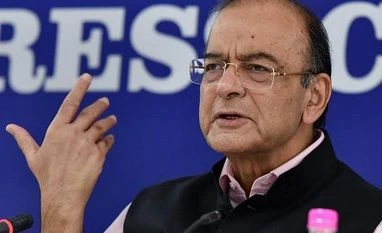
The emphasis on reforms needed to be accompanied by social consciousness, said Jaitley.
In 2022, India celebrates the 75th anniversary of its Independence. By then, the government's target is to make India a $4-trillion economy.
Modi had earlier given a clarion call for establishing a New India by 2022. On Tuesday, NITI Aayog CEO Amitabh Kant had said achieving a double-digit growth rate in the manufacturing sector on a sustainable basis was a "doable challenge" but the country needed to integrate with global markets for that.
At the release of the strategy paper, in an apparent attack on the Opposition, Jaitley said sound policy, not slogans would help in alleviating poverty and fulfilling the aspirations of people.
To read the entire document, click HERE
- 'Strategy for New India @ 75' identified 41 different areas that require either a sharper focus on implementing the flagship schemes already in place or a new design and initiative to achieve goals.
- Each chapter summarizes the current status of the sector, takes cognizance of the progress made thus far and spells out the objectives.
- NITI Aayog has pitched for completing labour reforms, increasing participation of women workers, implementing minimum wage, improving employment data collection and broadening social security in its 'Strategy for New India @75' document.
- The Aayog also made a case for easing industrial relations to encourage formalisation, saying there should be increase in severance pay, in line with global best practices.
- It also asked for overhauling the labour dispute resolution system to resolve disputes quickly, fairly and at low cost and strengthening labour courts/tribunals for timely dispute resolution.
- Calling for enhancing skills and apprenticeships, the Aayog said the Labour Market Information System (LMIS) is important for identifying skill shortages, training needs and employment created.
- It said LMIS should be made functional urgently and government should ensure the wider use of apprenticeship programmes by all enterprises which may require an enhancement of the stipend amount paid by the government.
- On labour law reforms, it has suggested completing the codification of labour laws at the earliest and pitched for simplification and modification of labour laws applicable to the formal sector to introduce an optimum combination of flexibility and security.
- It said the government should make the compliance of working conditions regulations more effective and transparent and the National Policy for Domestic Workers needs to be brought in at the earliest to recognise their rights and promote better working conditions.
- About enhancing female labour force participation, it said the government should ensure employers' adherence to the recently passed Maternity Benefit (Amendment) Act, 2017, and the Sexual Harassment of Women at Work Place (Prevention, Prohibition and Redressal) Act.
- It is also important to ensure implementation of these legislations in the informal sector and make sure that skills training programmes and apprenticeships include women, the document said.
- On employment data, it said that government should ensure that data collection for the Periodic Labour Force Survey (PFLS) of households initiated in April 2017 is completed as per schedule and data disseminated by 2019.
- It also asked the government to conduct an annual enterprise survey using the Goods and Service Tax Network (GSTN) as the sample frame and increase the use of administrative data, namely EPFO, ESIC and the NPS, to track regularly the state of employment while adjusting for the formalisation of the workforce.
- About wages, it said the government should make compliance with the national floor level minimum wage mandatory and expand the Minimum Wages Act, 1948, to cover all jobs, besides enforcing the payment of wages through cheque or Aadhaar-enabled payments for all.
- On social security and working conditions, it asked the government to enact a comprehensive occupational health and safety legislation based on risk assessment and employer-worker cooperation.
- It said workers' housing on site will help to improve global competitiveness of the Indian industry, along with enhancing workers' welfare.
- It also recommended enhancing occupational safety and health (OSH) in the informal sector through capacity building and targeted programmes and ensuring compulsory registration of all establishments to ensure better monitoring of occupational safety as well as recreation and sanitation facilities.
- It also made a case for enhancing transparency in the labour inspection system by allowing online complaints and putting in place a standardised and clear mechanism.
- About the constraints, it said a large share of India's workforce is employed in low productivity activities with low levels of remuneration across industry sectors, which is especially true of the informal sector where wages can be one-twentieth of those in firms producing the same goods or services but in the formal sector.
- It pointed out that a large number of workers that are engaged in the unorganised sector are not covered by labour regulations and social security. This dualistic nature of the labour market in India may be a result of the complex and large number of labour laws that make compliance very costly.
- In 2016, there were 44 labour laws under the statute of the Central government. More than 100 laws fall under the jurisdiction of state governments. The multiplicity and complexity of laws makes compliance and enforcement difficult, it said.
- It also said according to the India Skill Report 2018, only 47 per cent of those coming out of higher educational institutions are employable.
One subscription. Two world-class reads.
Already subscribed? Log in
Subscribe to read the full story →
Smart Quarterly
₹900
3 Months
₹300/Month
Smart Essential
₹2,700
1 Year
₹225/Month
Super Saver
₹3,900
2 Years
₹162/Month
Renews automatically, cancel anytime
Here’s what’s included in our digital subscription plans
Exclusive premium stories online
Over 30 premium stories daily, handpicked by our editors


Complimentary Access to The New York Times
News, Games, Cooking, Audio, Wirecutter & The Athletic
Business Standard Epaper
Digital replica of our daily newspaper — with options to read, save, and share


Curated Newsletters
Insights on markets, finance, politics, tech, and more delivered to your inbox
Market Analysis & Investment Insights
In-depth market analysis & insights with access to The Smart Investor


Archives
Repository of articles and publications dating back to 1997
Ad-free Reading
Uninterrupted reading experience with no advertisements


Seamless Access Across All Devices
Access Business Standard across devices — mobile, tablet, or PC, via web or app
)