Note ban boost to digital payments continues: Study

Two-thirds of respondents would continue to use non-cash payments if there is ease in doing so
noteban
.
Indivjal Dhasmana New Delhi
Last Updated : Mar 09 2017 | 12:14 AM IST
About a third of those who were using cheques, plastic money or non-cash payments after demonetisation would now go back to cash for many reasons, including behavioral ones, according to a study conducted by US-based financial inclusion consultancy firm MicroSave. 

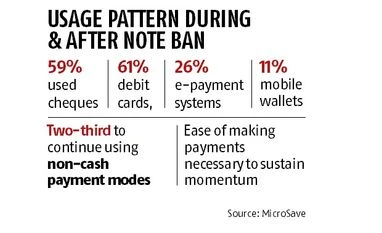
This also means two-thirds would continue to use non-cash payment modes, provided there is ease in doing so, revealed the survey, conducted to gauge how the pattern of transactions had changed after demonetisation.

Prime Minister Narendra Modi had on November 8 demonetised Rs 500 and Rs 1,000 notes, sucking out 86 per cent of cash from the economy and forcing a large number of people to switch to non-cash payment.

Manoj Sharma, managing director, Asia-Pacific, MicroSave, said the study covered Rajasthan, Uttar Pradesh, Madhya Pradesh and West Bengal. As many as 66 per cent of those covered said they would use non-cash payment systems if sufficient digital acceptance points were developed and training was provided on digital financial services. However, 34 per cent said they would return to using cash because of behavioural and functional issues. 


Behavioural issues means those related to trust, perception and risk. Functional issues are awareness, usability and costs, infrastructural and grievance redress. Fifty-nine per cent said they used cheques, 61 per cent debit cards, 26 per cent e-payment systems and 11 per cent mobile wallets. Since every respondent might have used more than one mode, the total is more than 100. Also, 51 per cent more people used cheques after the ban on the use of Rs 500 and Rs 1,000 currency notes, but 8 per cent decreased it as well. 

Forty-one per cent retained use of cheques. Among users of debit cards, 22 per cent increased it and 23 per cent decreased. Those who decreased their use attributed it to long queues at automatic teller machines since November 10.

One subscription. Two world-class reads.

Already subscribed? Log in

Subscribe to read the full story →
*Subscribe to Business Standard digital and get complimentary access to The New York Times

Smart Quarterly

₹900

3 Months

₹300/Month

SAVE 25%

Smart Essential

₹2,700

1 Year

₹225/Month

SAVE 46%
*Complimentary New York Times access for the 2nd year will be given after 12 months

Super Saver

₹3,900

2 Years

₹162/Month

Subscribe

Renews automatically, cancel anytime

Here’s what’s included in our digital subscription plans

Exclusive premium stories online

  • Over 30 premium stories daily, handpicked by our editors

Complimentary Access to The New York Times

  • News, Games, Cooking, Audio, Wirecutter & The Athletic

Business Standard Epaper

  • Digital replica of our daily newspaper — with options to read, save, and share

Curated Newsletters

  • Insights on markets, finance, politics, tech, and more delivered to your inbox

Market Analysis & Investment Insights

  • In-depth market analysis & insights with access to The Smart Investor

Archives

  • Repository of articles and publications dating back to 1997

Ad-free Reading

  • Uninterrupted reading experience with no advertisements

Seamless Access Across All Devices

  • Access Business Standard across devices — mobile, tablet, or PC, via web or app

Next Story



