Following the lead of Swedish company, Saab, Boeing has linked its offer to build a fighter aircraft in India with the promise of assistance in designing and building an Indian fifth-generation (Gen-5) fighter.
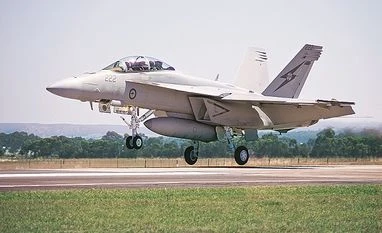
In a presentation to the Indian media in St Louis, Missouri, where Boeing builds the F/A-18E/F Super Hornet fighter, Boeing’s Dan Gillian, outlined a detailed road map from the Super Hornet to India’s Advanced Medium Combat Aircraft (AMCA), the Gen-5 fighter that the Defence R&D Organisation (DRDO) hopes to build.
Boeing’s plan involves first setting up an Indian factory and the aerospace ecosystem to build the Block II Super Hornet, which will then be improved into the “Advanced Super Hornet”. That infrastructure and design capability would give Indian designers the instruments to build the AMCA.
Boeing’s India chief, Pratyush Kumar, hardly disguises his scepticism of Saab’s promise to help India in designing the AMCA.
“America is the only country that has actually designed and manufactured stealthy, Gen-5 fighters”, points out Kumar. “Stealth design is not a science, it is an art that is developed only after years of trial and error. Boeing has actually mastered that art while co-designing the F-22 fighter.”
Boeing is not in direct competition with Saab, which is pitching to build 100-200 single-engine fighters in India. Instead, Boeing will compete with European manufacturers, Dassault, and Eurofighter, to establish a factory that will churn out a similar number of twin-engine fighters.
The Indian Air Force (IAF) has already solicited interest from global aerospace vendors in the single-engine category, and a similar request is expected soon for building twin-engine fighters.
Kumar claims the F/A-18E/F, which was designed in the 1990s, is a decade more contemporary than its rivals like the Rafale and the Eurofighter Typhoon, which started being designed in the 1980s.
“The Super Hornet is sometimes confused with the older F/A-18A/B Hornet fighter, which dates back to the 1970s. While they are superficially similar, the Super Hornet’s brand new design incorporates a high degree of stealth. For America, the Super Hornet was a stepping stone to the F-35, and it can be a stepping stone to the AMCA for India,” argues Kumar.
Boeing’s new Super Hornet factory in St Louis is churning out two Super Hornets each month for the US Navy, which will continue inducting the fighter well into the 2020s.
Each of America’s 9-12 aircraft carriers (the final number will depend upon President Donald Trump’s defence policy) will embark four squadrons of Super Hornets until 2028, when the F-35 Lightning II starts being inducted in significant numbers.
By 2028, each carrier will have one squadron of the F-35, and by 2035 there will be two squadrons each of the Super Hornet and the F-35.
“But the fighter will remain in service out to the 2040s and, until then, we will be developing upgrades every two years as part of a continuous development programme”, says Gillian. The first improvement on the cards is an advanced cockpit system in 2018-19.
Also being developed, even without US Navy sanction and funding, are “conformal fuel tanks” that will extend the fighter’s 1,000-km strike range by 200 km; and a more powerful and fuel-economical F-414 engine that will increase the thrust by 18 per cent. He says the Super Hornet is highly regarded by the US Navy not just because it is a capable and easy-to-maintain fighter, but also because it is the cheapest to operate in the entire US fighter fleet, even cheaper than the single-engine F-16.
“The US Government Accountability Office (GAO) rates the F/A-18E/F as the most economical fighter to operate on a cost per hour basis,” says Gillian.
The challenge for Boeing will be to build a supplier chain in India, like the one that feeds into the Super Hornet line at St Louis. This consists of 800 vendors in 44 states, which employ 60,000 people.
Boeing’s current Super Hornet vendors in India include Bharat Electronics Ltd (BEL), which builds electrical panels; while Hindustan Aeronautics Ltd (HAL) is building wire bundles and gun bay doors. Smaller companies are also joining the supply chain, including Rossell and SASMOS, which supply electrical equipment.

 "Only America can help India build fifth-generation fighters: Boeing")


 Connect with us on WhatsApp