Paddy sowing sees a spurt across the country
MET says eastern and southern regions which produce more than 80% of the country's annual produce is expected to get normal rains
Sanjeeb Mukherjee New Delhi As the southwest monsoon makes stupendous progress across large parts of the country, reaching most areas a week to 10 days ahead of schedule, the sowing of paddy, the most important foodgrain grown during the kharif season, has started on a brisk note.
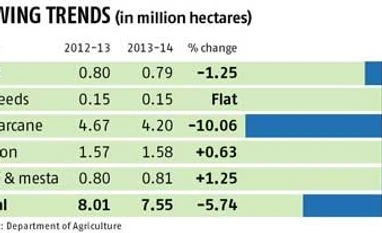
According to the latest data by the department of agriculture, paddy had been sown in 0.79 million hectares till
June 13, just 1.25 per cent less than last year. According to experts, the pace of sowing will pick up as the monsoon advances over the remaining parts of the country. Till June 14, almost two-thirds of the country had been covered by the monsoon and the rest is expected to be covered by the end of June. July is the most important month for sowing of kharif crops and according to the latest prediction of the India Metereological Department, rains in July are expected to be normal.
“Though these are very early days and the major thrust in sowing will come around July, the initial signs are very encouraging,” a senior official from the department of agriculture said.
The Secretary of the Consortium of Indian Farmers Associations (Cifa), P Chengal Reddy said there was every possibility India might harvest 100 million tonnes of rice in 2013-14, if the monsoon remained on course. India produced 93 million tonnes of rice in the previous year.
“The use of hybrid seeds has increased manifold across Uttar Pradesh, Bihar, West Bengal and Jharkhand, which will lead to higher productivity. Plus, the rains have been really good so far,” Reddy said.
He said the big problem will arise in marketing and procurement of this bumper harvest and the government should immediately start taking measures so farmers are not distressed when the actual crop starts hitting the market. Among the major paddy producing states, sowing is more in Uttar Pradesh, West Bengal and Karnataka, compared to the same period last year.
Paddy is sown in about 39 million hectares during the entire kharif season.
In its latest weekly update for the monsoon, the met department said overall rain was 28 percent above normal till June 13. Almost all regions, barring Haryana and Chandigarh, received above the normal rain during the same period.
Going forward, the met office said rain over the eastern and southern parts of the country, which produce 80 per cent of the country’s total annual paddy, are expected to be normal in 2013. Eastern India is expected to get rains equivalent to 98 per cent of Long Period Average, the well within the normal range.
Data from the department of agriculture show oilseeds were sown in 157,000 hectares till June 13, marginally more than last year’s corresponding period. Cotton has been planted in 1.58 million hectares, 0.6 per cent more than last year’s.
The only laggard has been sugarcane planted in 4.20 million hectares till Thursday, 10.06 per cent less than during the corresponding period last year.
“The drop in sugarcane estimate is mainly due to large-scale drought in parts of Maharashtra, Gujarat and Karnataka this year,” another official said.
Officials said sugar production in 2013-14 is estimated to fall 10 per cent to 22 million tonnes because of lower sowing.
In total, crops have been sown in eight million hectares till June 13 out of 75 million hectares of land on which kharif crops are sown.

 "Paddy sowing sees a spurt across the country")


 Connect with us on WhatsApp