Poplars are sweeter than cane
In west UP, many find tree farming more rewarding and less stressful than growing ubiquitous sugarcane
Akshat Kaushal Muzaffarnagar (West UP) Dheeraj Tyagi’s family has planted sugarcane for generations. However, two years earlier, troubled by falling revenue from the cane trade, he began looking at options. One was fencing the four sides of his 15-acre farm with poplar trees.
“Everyone around me was planting these,” says Tyagi, 40, as he admires his 1,000-odd trees. He says after three years, each tree was likely to fetch him around Rs 800, against an investment of less than Rs 50 a tree. “The profit is much higher as compared to sugarcane,” he adds.
In western Uttar Pradesh (UP), alongside National Highway 58, tracts of land earlier occupied by cane are being cleared to make way for these trees. Tall, lanky and with a short crown, these are unmistakable from a distance. Where these are not being planted and water availability is less, farmers are taking to guava and mango. However, the reasons for deserting sugarcane remain the same.
According to farmers here, apart from the substantially higher profit that poplar gets, rising input costs and falling profits were the main reasons to shift out of cane farming. Most farmers expressed concern over the rising cost of agricultural labour. Added to this was the recent impasse between mill owners and cane farmers, which had forced the farmers to look at alternatives.
A native of America, poplar trees were introduced in the 1950s in India. Popular in northern India as part of agro-forestry, these trees were preferred by farmers in Punjab, Haryana and west UP over the then ubiquitous eucalyptus. Poplar had more biomass growth and was more compatible with agricultural crops. It also got them a higher price in the timber market, as poplar is needed for manufacture of cricket bats and matchsticks. Further, because of its narrow crown, the tree was preferred as it could be combined with wheat and sugarcane.
Most farmers here are, at present, looking at poplar and vegetables only to supplement their income. However, they aren’t averse to moving away from the sugarcane trade in the near future. “What (else) will we do if the government (continues to) exploit(s) us?” asks Shyamvir.
So far, however, the trend away from sugarcane has not been captured by statistics. Contrary to the popular sentiment on the ground, the data of Indian Sugar Mills Association (Isma) shows the area under cane at a five-year high. “We don’t see farmers deserting sugarcane farming,” says Abinash Verma, director-general at Isma.
Yet, like Tyagi, for most farmers here, planting of these trees is also one way of getting out of agriculture. Tyagi complains: “There is too much uncertainty for few gains in agriculture”.
He says his long-term plans are ready. These include investing back the profit from the sale of trees in building a senior secondary school. And, investing back the combined profit to build a dhaba alongside his farm.

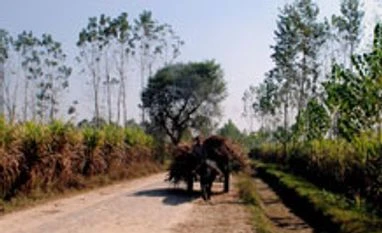 "Poplars are sweeter than cane")


 Connect with us on WhatsApp