RBI Governor expresses dilemma on monetary policy forward guidance
Faces challenge to ensure that the market does not become hostage to its guidance
BS Reporter Mumbai The Reserve Bank of India (RBI) on Wednesday said that giving forward guidance on monetary policy pose challenges.
“We have started the practice of giving forward guidance on monetary policy. Because of its potential impact, we pay much more attention to the language and nuancing of the ‘forward guidance’ paragraphs than other parts of the statement. Our experience in this regard has been quite positive. Nevertheless, we face some challenges,” said D Subbarao, governor, RBI in London.
According to him forward guidance is always conditional. “The dilemma then is how precisely the conditionality is to be communicated, and how to ensure that the market does not ignore the conditionality and interpret the guidance as an irrevocable commitment. Conversely, how does the central bank ensure that it does not become hostage to its guidance? Also, the more uncertain the situation, the greater the need for guidance. But also, the more uncertain the situation, the more difficult it is to give definitive guidance,” said Subbarao.
Subbarao given an example and says that when the forward outlook is uncertain, they are not able to precisely define the conditions under which the guidance holds and the conditions under which they may have to deviate from it. “When we are not forthcoming on specifying the conditions, the market starts speculating on them, thereby raising the ‘noise’ to message ratio,” said Subbarao.
Subbarao also said that RBI intervenes in the forex market to smooth excess volatility. “We let our exchange rate be largely market determined, but intervene in the market to smooth excess volatility and/or to prevent disruptions to macroeconomic stability,” he said. In the recent past RBI has been intervening heavily to strengthen the rupee.
Earlier this month the rupee touched an all-time high of Rs 61.22 per dollar. However, the rupee recovered as RBI sold dollars through public sector banks. RBI data released on Friday shows that the total reserves fell by $ 3 billion during the week and stood at $ 285 billion as on June 28.
According to Subbarao our capital account is only partly open; while foreigners enjoy mostly unfettered access to our equity markets, access to debt markets is restricted; there are limits to the quantum of funds resident corporates and individuals can take out for investment abroad, but the limits are quite liberal, he said. Subbarao added that because of the liberalization on the exchange rate and capital account fronts, some monetary policy independence is forfeited.
“What the middle solution also implies is that we have to guard on all the three fronts with the relative emphasis across the three pillars shifting according to our macroeconomic situation,” said Subbarao.
According to Subbarao by far the biggest concern stemming from the large fiscal deficit, especially from RBI’s perspective, is that it adds to aggregate demand and thereby to inflation pressures. By crowding out the private sector, the fiscal deficit could also inhibit, if not impair, monetary policy transmission to the private sector. Credible fiscal consolidation is, therefore, a necessary pre-condition for stabilizing inflation and securing non-inflationary growth, he said.
Subbarao is of the view that economies will be best served if governments ensure that their central banks are able to conduct monetary policy independently and free of fiscal compulsions. This will require, among other things, responsible and credible fiscal consolidation.

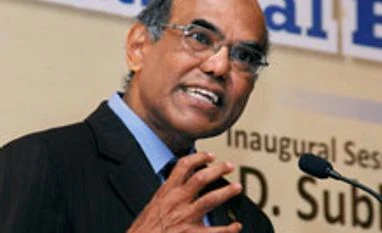 "RBI Governor expresses dilemma on monetary policy forward guidance")


 Connect with us on WhatsApp