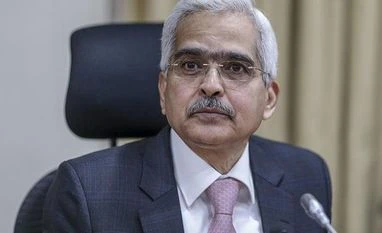
The Reserve Bank of India (RBI) is working closely with the central government to enable international settlement of government securities (G-Secs) and incorporation of local bonds into global bond indices to broaden the investor base, said RBI Governor Shaktikanta Das on Tuesday.
He reiterated his stance that the G-Sec is a "public good", as it is the benchmark for pricing various instruments in the economy. The RBI's endeavour has remained an "orderly evolution of the yield curve", with this in mind.
“The RBI, together with the government, is making efforts to enable international settlement of transactions in G-Secs through international central securities depositories,” said Das.
“Once operationalised, this will enhance access of non-residents to the G-Sec market, as will the inclusion of Indian G-Secs in global bond indices, for which efforts are ongoing,” he said, while delivering his keynote address at the annual event of FIMMDA-PDAI - two bond investor association bodies.
Fixed Income Money Market and Derivatives Association of India (FIMMDA) and Primary Dealers' Association of India (PDAI) were having their 21st annual meeting virtually.
“Expansion of the investor base is key to further development of the market,” said the governor.
To widen the investor base, the RBI has introduced a ‘retail direct’ scheme for retail investors, which is expected to tap into existing savings of households towards the safest asset in the country.
He urged the FIMMDA-PDAI to focus more on the STRIPS (Separate Trading of Registered Interest and Principal of Securities) segment, so that it gains popularity among such investors.
The RBI governor quoted a Bank for International Settlements study that had found that the G-Sec market in India, measured in terms of outstanding stock as a per cent of gross domestic product, is large relative to most Asian peers, and the bid-ask spreads among the best.
Even as the Indian G-Sec markets remain “cutting-edge” and more sophisticated than others, there is still scope for the market to develop in sync with emerging requirements, he said.
For example, the secondary market liquidity dries up on several occasions and concentrates on a few securities and tenors, which results in “kinks” in the yield curve. He blamed the market microstructure in India, where ‘buy and hold’ and ‘long-only’ investors prevail, for this. “We need to develop a yield curve that is liquid across tenors,” he emphasised.
To prevent the G-Sec liquidity from drying up during periods of rising interest rates or in times of uncertainty, the governor stressed on alternatives. While there is a ‘special repo’ that enables borrowing of securities, discussions are also on to introduce Securities Lending and Borrowing mechanism that would enable insurance and pension firms to lend their securities in the market for a profit.
“I would urge that these discussions be carried forward with a view to evolving market-based mechanisms that enable the lending and borrowing of securities as part of the overall market development,” he said.
The RBI governor also stressed upon the need to develop interest rate derivatives markets further. Even as there is a wide range of products available in the market, the “only major liquid product” continues to be the Mumbai Interbank Offer Rate-based Overnight Indexed Swap market.
The participants in these markets are also largely limited to foreign banks, private banks, and primary dealers. However, he noted that the swaption (swap option) is gaining traction. Still, it could be an opportune time to consider new instruments to facilitate hedging of long-term interest rate and reinvestment risk by insurance companies, provident and pension funds, and the corporate sector.
“On its part, the RBI will endeavour to ensure adequate liquidity in the G-Sec market as an integral element of its effort to maintain comfortable liquidity conditions in the system,” he said.
The governor also said that even after its regular variable rate reverse repo auctions, through which the RBI plans to suck out up to Rs 4 trillion of excess liquidity from the market, the central bank will also conduct “fine-tuning operations from time to time as needed to manage unanticipated and one-off liquidity flows, so that liquid conditions in the system evolve in a balanced and evenly distributed manner”.