Home / Economy / News / 'Renewable energy capacity addition rises 80% to 3.4 GW during Dec quarter'
'Renewable energy capacity addition rises 80% to 3.4 GW during Dec quarter'
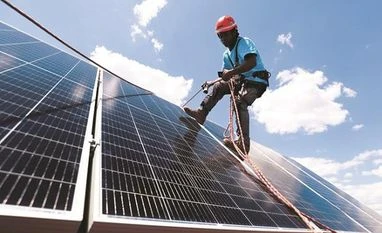
Solar energy comprised 92 per cent of the total RE capacity added during the quarter, driven partly by a 142 per cent rise in installations of rooftop solar to 700 megawatts (MW)
Solar energy comprised 92 per cent of the total RE capacity added during the quarter.
Renewable energy capacity addition increased 80 per cent to 3.4 gigawatts (GW) during the December 2021 quarter compared to a year ago, according to CEEW-CEF.
New capacity addition of non-hydro renewable energy increased to 3.4 GW during the third quarter of FY22, compared to just 1.9 GW installed in the same period last year (October-December 2020), according to the latest edition of the CEEW Centre for Energy Finance (CEEW-CEF) Market Handbook, according to a statement.
This is nearly an 80 per cent jump in new renewable energy (RE) capacity addition on a year-on-year basis.
However, it stated that compared to the preceding quarter (July-September), new non-hydro RE capacity additions fell 27 per cent on account of intensifying supply chain constraints.
Solar energy comprised 92 per cent of the total RE capacity added during the quarter, driven partly by a 142 per cent rise in installations of rooftop solar to 700 megawatts (MW). This growth in new capacity was registered despite a 40 per cent jump in the prices of solar PV modules to Rs 21 per watt-peak, over the last year, it stated.
An increase in the cost of raw materials and supply chain constraints resulted in rising solar PV module costs, it stated.
Overall, in terms of net capacity additions, renewable energy formed 75 per cent of the total 4.5 GW capacities added (net of 900 MW, which were converted to captive mode) in the power sector during the period, it stated.
During the quarter, coal-based power generation capacities of 2,095 MW were added in Rajasthan, Tamil Nadu and Bihar, it said.
The handbook showed that sales of electric vehicles jumped by over 250 per cent to over 1.3 lakh during the Q3 FY22, compared with around 34,000 units in the third quarter of last fiscal.
The surge in petrol prices, the introduction of new models along with incentives under the Faster Adoption and Manufacturing of Electric and Hybrid vehicle (FAME-II) scheme contributed to the growth in sales of zero-emission vehicles, especially electric two-wheelers.
(Only the headline and picture of this report may have been reworked by the Business Standard staff; the rest of the content is auto-generated from a syndicated feed.)

 "'Renewable energy capacity addition rises 80% to 3.4 GW during Dec quarter'")

