Timeline of events leading up to Right to Privacy being held as fundamental

From 1954 to 2017, these cases set a precedent for India
Right to Privacy in the Supreme Court: How we reached here
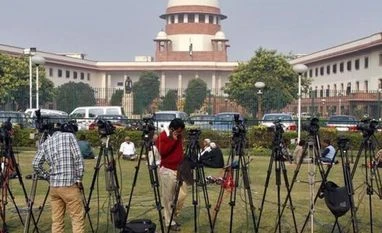
Tripods of television crew stand in front of the Indian Supreme Court building in New Delhi. Photo: Reuters
BS Web Team New Delhi
2 min read Last Updated : Jan 09 2020 | 4:46 PM IST
The Supreme Court on Thursday ruled that individual privacy is a fundamental right, in a far-reaching verdict that could derail Aadhaar, the world's largest biometric identification programme.

A nine-member bench was hearing petitions challenging the mandatory use of  Aadhaar, as an infringement of privacy. There have also been concerns over data breach.

History of the case
The contentious issue had emerged when the apex court was dealing with a batch of petitions challenging the Centre's move to make Aadhaar mandatory for availing the benefits of various social welfare schemes.

Initially, on July 7, a three-judge bench had said that all issues arising out of Aadhaar should finally be decided by a larger bench and the CJI would take a call on the need for setting up a constitution bench.

The matter was then mentioned before CJI Khehar who set up a five-judge constitution bench to hear the matter.

However, the five-judge constitution bench on July 18 decided to set up a nine-judge bench to decide whether the right to privacy can be declared a fundamental right under the Constitution.

The decision to set up the nine-judge bench was taken to examine the correctness of two apex court judgements delivered in the cases of Kharak Singh and M P Sharma, decided by six and eight judge benches respectively, in which it was held that this right was not a fundamental right.

While the Kharak Singh judgement was delivered in 1960, the M P Sharma verdict was reported in 1950.

Here is a timeline of how the Supreme Court had dealt with questions related to privacy over the years

One subscription. Two world-class reads.

Already subscribed? Log in

Subscribe to read the full story →
*Subscribe to Business Standard digital and get complimentary access to The New York Times

Smart Quarterly

₹900

3 Months

₹300/Month

SAVE 25%

Smart Essential

₹2,700

1 Year

₹225/Month

SAVE 46%
*Complimentary New York Times access for the 2nd year will be given after 12 months

Super Saver

₹3,900

2 Years

₹162/Month

Subscribe

Renews automatically, cancel anytime

Here’s what’s included in our digital subscription plans

Exclusive premium stories online

  • Over 30 premium stories daily, handpicked by our editors

Complimentary Access to The New York Times

  • News, Games, Cooking, Audio, Wirecutter & The Athletic

Business Standard Epaper

  • Digital replica of our daily newspaper — with options to read, save, and share

Curated Newsletters

  • Insights on markets, finance, politics, tech, and more delivered to your inbox

Market Analysis & Investment Insights

  • In-depth market analysis & insights with access to The Smart Investor

Archives

  • Repository of articles and publications dating back to 1997

Ad-free Reading

  • Uninterrupted reading experience with no advertisements

Seamless Access Across All Devices

  • Access Business Standard across devices — mobile, tablet, or PC, via web or app

Topics :Supreme Court

Next Story


