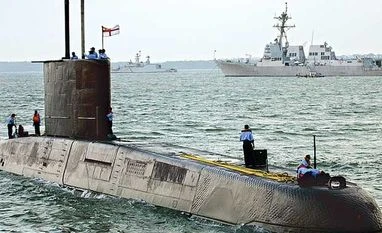
For over eight years, as Hindustan Shipyard Ltd (HSL), Visakhapatnam, has struggled to overhaul one of the navy's Kilo-class submarines - INS Sindhukirti - critics have flayed the shipyard for depriving the navy of a critical warship. HSL has never publicly explained the delay.
Yet, Business Standard found, during a detailed tour of HSL, that the delay has little to do with inefficiency or incompetence. Instead, much of the blame rests with a loosely framed contract with Moscow that has allowed Russian "experts" to incrementally extend the work to be done on the Sindhukirti, in one case to 13 times what was required for overhauling an Indian submarine in Russia.
The Russians who have worked at HSL since 2006, overseeing Sindhukirti's "modernisation-cum-refit" knew they were assisting a competitor. HSL's success would disrupt the lucrative flow of Indian submarines to Zvezdochka shipyard in Russia, which had long overhauled them for hundreds of crore rupees each.
"INS Sindhukirti will complete its refit by March 31, when it will rejoin the navy fleet. But the experience of overhauling this submarine holds major lessons for Indian shipyards," says HSL chairman, Rear Admiral N K Mishra (retired).
An overhaul, or refit, conducted every 10 to 15 years, extends a submarine's life by repairing its hull and modernising its combat capability. It involves examining, repairing and even replacing parts of the hull (two hulls in the Kilo-class, an inner "pressure hull" and an outer hull); replacing worn-out cabling; and replacing or upgrading major weapons, sensors and communication systems.
Business Standard has compared the work that Russian "experts" at HSL ordered on the Sindhukirti, with that done on two submarines earlier - INS Sindhughosh, refitted in Russia; and INS Sindhudhvaj, refitted in the Naval Dockyard, Visakhapatnam (see chart). In each work category, the Sindhukirti has required several times the work done on the Sindhughosh and Sindhudhvaj.
Tellingly, this was not anticipated in the preliminary work estimation, which was in line with earlier refit experiences. Shipyard workers recount (and the figures endorse) that the work only ballooned after it began, with Russian overseers repeatedly ordering work extensions.
The "pressure hull build up" - in which pits on the hull surface are filled with metal -doubled. So did the "frame renewal", or replacement of the metal framework that supports the hull. The grinding work expanded almost threefold. The time-consuming and costly work of replacing entire hull plates went up 13-fold from what the Sindhughosh required in Russia. The conning tower, which was only repaired in earlier refits, had to be entirely rebuilt.
There are only two possible explanations: Either INS Sindhukirti, which the navy operated exactly like its other Kilo-class submarines, inexplicably underwent exceptional wear and tear; or else Russian experts ordered needless work extensions, for their own reasons. Senior navy officials say the former is unlikely.
Contacted for comments, the defence section of the Russian Embassy in Delhi has not responded.
Furthermore, INS Sindhukirti's refit involved extensive modernisation. Like the Sindhughosh and Sindhudvaj, its torpedo tubes were modified to fire Klub missiles against surface targets. Unlike them, it also got a new MCA inertial navigation suite, a Palady nerve system, and a Pirit ship control console. Bharat Electronics Ltd (BEL) installed indigenous Ushus sonar and upgraded communications. As the submarine was being reassembled, Russian overseers ordered a time-consuming replacement of all the main-line cabling.
"When Russia overhauls a submarine, the work package is frozen at the time the contract is signed. But we had no experience of framing a contract. We allowed the Russians to indefinitely increase the work required, which kept expanding," recounts Commodore Ashok Bhal (retired), director of the Sindhukirti refit.
Russia has historically taken two and a half years or more to refit a Kilo-class submarine. The Sindhukirti will have taken three-and-a-half times longer, with its expanded work package and a series of major modifications and upgrades. Time has also been expended in developing worker skills. It is today the only Indian shipyard that has actually refitted a Kilo-class submarine.
Even so, the shipyard has been denied any role in overhauling six Indian Navy submarines, a Rs 4,800-crore project that the defence ministry cleared on Friday. Two of these will go to Russia, while four are overhauled in India - two in Mazagon Dock Ltd (MDL), Mumbai, and two at Naval Dockyard, Mumbai.
HSL has been left out even though the shipyard was transferred in 2010 from the ministry of shipping to the ministry of defence, on the grounds that it would be central to the construction and overhaul of submarines.
Senior admirals lament the wastage of skills and experience. Former navy chief, Admiral Sureesh Mehta, points to how MDL developed submarines skills while building two vessels under licence from HDW of Germany. After allegations of bribery surfaced, HDW was blacklisted and construction of submarines in MDL halted. With the gradual dissipation of worker skills, the Scorpene construction project required skills to be developed afresh.
"The skills we have developed cannot be allowed to be wasted away", says Mishra, the HSL chief.

 "Russia delayed sub refit to weaken shipyard?")


 Connect with us on WhatsApp