In a landmark judgment, the Supreme Court on Thursday upheld the Right to Privacy as "a fundamental right" under Article 21 of the Indian Constitution, in a unanimous decision.
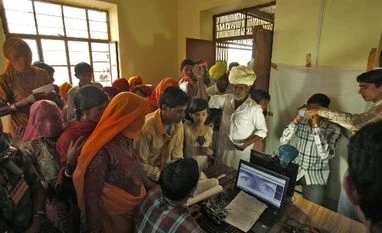
However, the verdict does not comment on whether the government's demand for Aadhaar to be linked to all financial transactions amounts to an infringement of privacy.
"The court has not said anything about whether Aadhaar is invalid or not," lawyer Prashant Bhushan was quoted as saying by television channels. "Right to privacy being a fundamental right means a lot for Aadhaar. It will now be seen whether the restrictions imposed by Aadhaar are reasonable restrictions or not," he added.
With the nine-judge Bench ruling against the government stand on privacy, Aadhaar case will be referred to a five-judge Bench. The Bench will hear several petitions challenging the validity of the Act.
The Congress party, which had launched Aadhaar when it was in power, welcomed the verdict. “Path-breaking and seminal judgment. A great victory for liberty and freedom... Supreme Court rejects Modi government’s attempt to whittle down the right to privacy,” party’s chief spokesperson Randeep Singh Surjewala tweeted.
Earlier, the Supreme Court had on August 2 reserved its judgment over the issue of whether right to privacy is fundamental or not.
On July 26, the Centre had told the apex court that there is a fundamental right to privacy, which is a 'wholly qualified right', too.
Attorney General, K K Venugopal told the apex court that "privacy, as a fundamental right, could have been mentioned in Article 21, but has been omitted. Right to life transcends right to privacy".
In special circumstances, the government can interfere in a matter that comes under a wholly qualified right. An absolute right cannot be reduced or amended.
On July 20, all the petitioners had completed their argument in the apex court. The petitioners contested that the 12-digit biometric unique identification card raised privacy threat. The petitioners stressed that the Aadhaar database was originally presented as a purely voluntary programme that offered to provide every Indian with an identity card while the government maintained Aadhaar was essential for all services, including tax returns, opening of bank accounts and securing loans, pensions and cash transfers for those entitled to welfare schemes.
On June 10, the top court had ruled that from July 1 every person eligible to obtain Aadhaar must quote their Aadhaar number or their Aadhaar Enrolment ID number for filing of Income Tax Returns, as well as for applications for Permanent Account Number (PAN).
The income-tax department has stepped up its efforts to encourage people to link their PAN with Aadhaar.