Growth in services, the dominating sector of India’s economy, declined to a four-month low in April, a widely-tracked Nikkei/Markit purchasing managers’ index (PMI) showed on Wednesday.
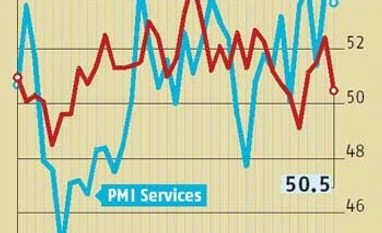
PMI fell to 53.7 points in April from 54.3 in March as new business grew slower than previous months. A reading above 50 is expansion and the one below is contraction. PMI for services was at a 19-month high at 54.3 in January, which was maintained in March.
Read more from our special coverage on "PMI"
The rate of growth in new business at services firms eased from March, when it had grown at the fastest pace in three years. In April, competitive pressures also continued to weigh on firms.
Sub-sector wise, financial intermediation and post & telecommunication boosted the services growth, while the transport & storage sub-sector turned around to growth after a considerable period of stagnation.
The April data highlighted a general lack of pressure on the capacity of Indian service providers, as unfinished business declined. The latest fall was the third in as many months, but the weakest in this sequence and fractional overall. Data released on Monday showed the manufacturing output also lost steam in April after new orders dried up. This resulted in PMI being slashed from the eight-month high of 52.4 in March to 50.5 in April.
This brought down the composite PMI output index to 52.8 points in April from 54.3 in March (37- month high), pointing to a softer expansion in the private sector activity across the country.
“A softer expansion in activity, combined with unchanged employment and a dip in business expectations among the services sector suggest companies are not fully convinced about the recovery and that March’s stronger numbers might have been one-off,” said Pollyanna
De Lima, economist at Markit and author of the report. The survey showed April was no different for job creation with almost all survey members reporting the same staffing levels as in March. Broadly stagnant employment trends have now been registered through the past nine months. Likewise, manufacturing payroll numbers remained unchanged.
For domestic services providers, reports of higher prices paid for fuel forced input costs to continue rising on average in April, marking an eight-month sequence of inflation. Input cost inflation at services firms were at a 13-month high. Concurrently, purchase costs faced by manufacturers also rose to its highest since May 2015.
The improving demand environment enabled service providers to continue to pass on to their clients’ part of the additional cost burden. However, in contrast to cost inflation, tariffs were raised at a slower rate.
Data released on Monday showed manufacturing output also lost steam in April after new orders dried up. This resulted in growth rates being slashed from the 8-month high of 52.4 in March to 50.50 in April. Consumer goods producers fared better than their counterparts producing intermediate and investment goods, who saw a decline in both output and new orders.
The services data also brought down the Nikkei India Composite PMI Output Index to 52.8 in April, from 54.3 in March (37-month high), pointing to a softer expansion in private sector activity across the country.
"A softer expansion in activity, combined with unchanged employment and a dip in business expectations among the services sector suggest that companies are not fully convinced about the recovery and that March’s stronger numbers might have been a one-off,” said Pollyanna De Lima, economist at Markit and author of the report.
With the 2015-16 financial year witnessing dismal merchandise trade, the government is betting big on services trade and consequently focusing on policy pushes to leverage India's growing strength in the sector. This include building competitiveness among various sectors and adopting services as an integral part of trade pacts with other countries. The Global Exhibition on Services (GES) organized by the commerce ministry focused on services export.
Currently, the Directorate General of Commercial Intelligence and Statistics and the Reserve Bank of India compile the data. The country currently accounts for less than 2% of global exports and comes in as the eighth-largest services exporter.

 "Services growth falls to 4-month low in April: PMI")


